Wednesday, June 17, 2020

How (and why) might we defund police?

It appears that when people say, "Defund the Police!" they often don't mean completely. They usually appear not to mean "dismantle the police force and don't replace it," although some do. 
I started examining the ideas of abolishing or defunding the police in the previous post on this blog.

Defund the Police, like Abolish the Police, is an arresting (sorry), but inadequate slogan. Like most ideas, if you take the logic to its farthest extreme, it's a terrible idea (hint: for real-life applications, never go to the farthest extreme). But people have begun to have valuable discussions about the way forward.

This political cartoon by Kevin Sies shows two protesters with a very long banner full of many catch-phrases on police reform

Deciphering what they actually mean


In the simplest statements I've heard, the idea is to reallocate some funds from the local police department. Then to spend them building up departments that would be more appropriate responders to certain kinds of situations. Police solutions often end with someone arrested or ticketed, possibly taken to jail. That's appropriate for some things, but not for others.

For example, if it's a mental health crisis, deploy some kind of mental health equivalent of EMTs (and yes, I know we don't have those yet). This would radically reduce the number of incidents in which a mentally ill person in crisis (but mostly a danger only to themselves) isn't confronted, further agitated, and then eventually killed by police.

Another example we often hear cited is when police are called to deal with persons experiencing homelessness. What do these people need? Certainly a better place to live. Many also need mental health counseling, physical health care, possibly addiction treatment, additional education so they can find a job, or other services. What can police do about them? Usually none of those things. They can arrest them, or force them to go somewhere else. That's pretty much it.

A large, multi-spout teapot labeled "Defund the Police" pours tea into cups marked "education," "universal healthcare," "youth services," "housing," and "other community reinvestments."
(Illustration courtesy of Aleksey Weintraub, @LAKUTIS via Twitter)


Why many say policing itself needs a re-think


Diversity training is only as good as the trainer who teaches, and the personal investment of the people who show up. Until individual officers take the messages to heart--and until there's greater diversity and cross-cultural understanding in most police departments, cultural clashes will continue to fuel bad outcomes.


Even when radical overhauls happen, there's often still a gap between desire and result. It's discouraging. But allowing ourselves to feel defeated and saying, "I give up" isn't a sustainable solution. Sweeping problems (and problem officers) under the rug doesn't work. Perpetuating and doubling-down on "how we've always done things" doesn't cut it. We've been doing that for decades, and the results keep getting more extreme.

A city worker power-washes "Defund the Police" from the road outside the Atlanta Police Department, after the protests in Atlanta. When the protests subside, will calls for reform be as easy to erase or ignore? (Photo by Alyssa Pointer/Atlanta Journal-Constitution)

What is policing supposed to do?

It gets down to questioning the very purpose of policing. Why do we have police? To keep public order, so we feel safer in our neighborhoods? To respond to (or ideally limit/prevent) crimes such as murder, assault, rape, fraud, and similar invasions of property and person? 

Do they have a role in limiting vandalism, truancy, and roving bands of unoccupied youths, or should other programs address those ills?


De-criminalizing our society


Many proposals start with a laundry-list of things to de-criminalize. I've already mentioned de-criminalizing homelessness in this article. A strong case also can be made for de-criminalizing addiction and drug possession. 


De-criminalizing poverty is another consideration. We could do this in part by examining all proposed statutes, civil codes, and local ordinances to see which disproportionately afflict poor people. Another good starting place might be not over-policing poor and minority neighborhoods.

This cartoon by artist Barrie Maguire makes the point that de-criminalizing drug addiction would free up jail space.
Decriminalizing addiction, drug use and other "offenses" that could better be handled by other agencies would also free up jail space (Barrie Maguire cartoon courtesy of the Philadelpha Inquirer).

Where do we go from here?

Some"de-fund" arguments focus, not on policing itself, but on problems that perpetuate the conditions that encourage crime. 

Even before the pandemic threw them into glaring prominence, inequalities in educational opportunities, in health care, in food security and economic opportunity were major concerns. So it's not surprising inequities claim prominent places on many people's "to-reform" lists. Yet all of those things get less money from local governments than policing. Many cities' biggest budget item is its public safety budget.

Some observers fear we're rushing into things with half-baked approaches to revamping police forces or radically altering them. Others fear we'll only use half-measures, then reluctant politicians will have an "out" to declare, "well, that didn't work!" a few weeks or years from now.

But what if we were really serious about this? What if we actually tried a well-thought-out plan to readjust the way we do social well-being, including efforts to ensure law, order, and justice for everyone? For real.

I think we're all still trying to figure out how that would look. But next week in this space, I'll take a stab at relating my own vision and thoughts to my stories about policing in the future on Rana Station.

IMAGE CREDITS:

Many thanks to the Charlotte Observer/McClatchey, for the Kevin Siers cartoon. The "Defund the Police Teapot" illustration is from Aleksey Weintraub, @LAKUTIS via Twitter. It appears to be a clever adaptation of a photo of an actual, multi-spout teapot from Tea Exporter India (now a defunct link) via Alobha Exim's Pinterest board. The photo of the city worker power-washing the street in front of the Atlanta Police Department is by the formidable Alyssa Pointer of the Atlanta Journal-Constitution The remarkable Barrie Maguire (who also did a stint at Kansas City's own Hallmark) is a marvelous fine-art painter of Irish-inspired work, but he also created cartoons for the Philadelphia Inquirer for a while, including this one dramatizing prison overcrowding.

Wednesday, June 10, 2020

Abolish the police?

If we abolish the police in the 21st Century, why should people need XK9s in the future? 

Wait! That wasn't the question at the top of your mind?
Here are the covers of the two books Jan had out in June 2020, "The Other Side of Fear," and "What's Bred in the Bone."
Learn more about Jan's XK9 Books on her website. She writes science fiction police procedurals about sapient police dogs on a space station. Cover artwork for The Other Side of Fear is © 2020 by Lucy A. Synk; Cover artwork for What’s Bred in the Bone is © 2019 by Jody A. Lee

Actually, it wasn't my first question, either (although I do have answers). When I originally learned about the movement to abolish the police, my first question was why would we do that? 

Then I realized that by asking that question I had already marked myself as a person who owns property and benefits from white privilege. 

Clearly, there was a disconnect happening. I needed to remedy it by educating myself.

Why would we abolish the police?


Let's start with my "Why would we abolish the police?" question. The answer depends on why the questioner thinks the police exist. Well, their motto is "to protect and serve." But protect what? Serve whom? That's where it starts to get dicey. 

This meme shows police violently throwing a protester on the ground. The superimposed words read "Protect and serve Yer doin it wrong"
(Meme courtesy of Cheezeburger.)


Functionally, throughout their history police forces have existed to protect the property and persons of some of the people from basically everyone else (except when they don't protect property or the personal safety of civilians). And in recent days we've heard many authorities cite "protecting property from destruction" as a reason for cracking down on protesters who linger past curfews.

They also don't exist to protect public safety in all the ways we tend to believe they do. Did you know that according to the Supreme Court, the police are not obligated to protect a person from physical harm, even when it is threatened? 

Above all, they primarily exist to serve the current power structure, for well or ill. And that's a big part of the problem. If you have a racist or corrupt power structure, police exist to support it. 

Police in riot gear advance in a line through billowing blue tear gas smoke, with their batons out.
Minneapolis police advance through tear gas on a group of protesters. (Photo courtesy of Scott Olson/Getty Images, via NPR).

Do we have a racist or corruptible power structure in the USA?


I feel kind of silly, even writing that question. Of course we do.

We certainly have a racist power structure in the USA. If anyone can have lived through the last several years and still doubt that, they probably live in a gated community, are relatively wealthy, white, and only watch Fox News. In other words, they very carefully tune out many distressing aspects of reality. 

But you can't close your eyes, cover your ears, yell "La-la-la-la!" and magically transport yourself into a post-racial America. No such place exists.


A person holds a poster that lists all kinds of things people weren't safely able to do "while black."
The most discouraging part? This list only hits the "famous ones." (photo courtesy of KISS).


But wait! The police are the "good guys!" Right?


A white DC police officer interacts pleasantly with several black kids, in a demonstration of community policing.
The District of Columbia has been at the forefront of the "community policing" effort. But is it enough? Many don't think so. (Photo courtesy of Governing)


But again, whether you view them as good guys or not depends on your experiences. After some of the experiences and understandings explored in this blog post, you may be starting to feel less happy with the police.

But . . . abolish the police? Entirely? Is that realistic? And is it even remotely desirable? Don't we actually need the police for a lot of important things? 

What about murders? What about armed robbery? Car theft? Rape? Human trafficking? Fraud? How would we deal with those things, if there were no police? I have yet to find comprehensive answers from the "abolish" advocates, other than promoting a decentralized approach that parcels out some duties to other agencies. 

But unpacking many of the angles will take at least another blog post or so. I'm looking forward to examining how the "abolish" and "defund" advocates may turn out to inform (or not) the process of reforming, reducing or in some cases completely dismantling the ways policing is done--as well as implications for the future (both ours in reality, and in my science fiction).

IMAGE CREDITS:

The covers of Jan's books are from her website. The meme about protecting and serving "the right way" is from Cheezeburger. The photo of the cops and the tear gas is courtesy of Scott Olson/Getty Images, via NPR. The very long list of unsafe things to do "while black" is from KISS, and the photo of the officer doing "community policing" is from Governing. Many thanks to all!


Wednesday, June 3, 2020

Crossing the line

The phrase "crossing the line" has a special resonance for me today. 

Crossing a deadly line


Like many metro areas in the United States over the recent weekend, mine saw day after day of large, mostly peaceful crowds demonstrating in the streets. The protesters came out to decry the actions of four Minneapolis police officers who slowly (it took almost nine minutes), publicly, murdered a man in the street by kneeling on his neck and back. 

Protesters hold signs and give speeches at a march for justice in Kansas City
Nareen Stokes, mother of Ryan Stokes, a local man killed by police, speaks to the then-peaceful crowd in Mill Creek Park near the Kansas City Country Club Plaza. (Photo by Carlos Moreno. Many thanks to KCUR Kansas City).


That's a deadly example of "crossing the line" that should never, ever be condoned. But that kind of "crossing the line"--extra-rough treatment of people from certain neighborhoods, with a certain skin color--by police happens all too often. 

Is there a systemic racism problem, or is it just a whole lot of unfortunate, isolated incidents? How you answer that question probably depends on your background, experiences and race. There's even disagreement among police. Black officers see more of a problem than white officers, in recent polling.

Certainly, the officers in the George Floyd case crossed a line, although getting charges and convictions will be difficult. This wasn't the first time Officer Derek Chauvin, the neck-kneeler, got in trouble for mistreating citizens, although one hopes it is the last.

Why do police officers cross those ethical lines? 


Anyone who has followed my blog for any length of time knows I'm not a hater of the police. I'm concerned about their well-being, inspired by their service, and generally convinced that we'd be in a world of hurt without them. I write novels about (mostly) admirable law enforcement officers, and I do my level best to extrapolate realistically into my futuristic world.

But people are people. While most applicants go into law enforcement with good motives, no profession is populated solely by angels. And although many seek an exciting career, police work may be more than they bargained for. The job gives officers a front-row seat on more trauma and ugliness than most civilians would see in several dozen lifetimes.

A poster available on Amazon lists danger signs of officer stress
A poster available on Amazon lists danger signs of officer stress, and management cues. (image courtesy of Police Posters on Amazon).


Wounded, traumatized people can grow callous or violent. A persistent old-school police culture further tends to ignore the advice of psychologists about dealing with stress. Instead, there's pressure to "suck it up" and get on with the job. To self-medicate for depression or stress with alcohol or other substances. Nobody does their best work while drugged.

Crossing other lines


Unfortunately, I need to get back to those protests I mentioned at the beginning of this piece. Because although during the day most protesters peacefully exercised their First Amendment rights, things changed at night. 

Night after night, rioters have vandalized, looted, and burned businesses and cars. It happened here in Kansas City, and in many other cities, too. One shocking casualty that hit the science fiction community extra-hard was the loss of the legendary Uncle Hugo's Science Fiction Bookstore in Minneapolis.

It's as if the transition from day to night turned people mean. In part, it seemed to become a self-fulfilling cycle. Authorities imposed curfews, in an effort to prevent violence. Police attempted to disperse crowds, in many cases using tear gas or pepper spray. Angry protesters fought back, and all hell broke loose.

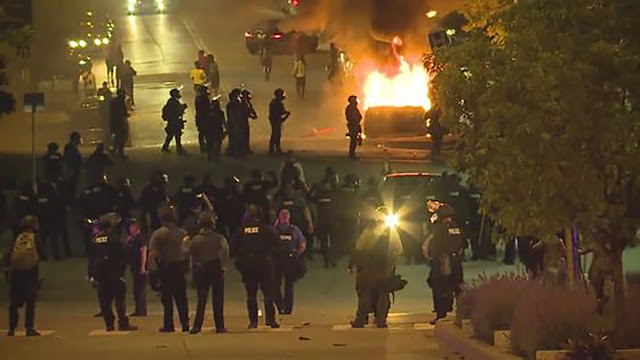
After dark, the protests turned uglier. A Kansas City PD vehicle burns on Saturday night.
After dark, the protests turned uglier. A Kansas City PD vehicle burns on Saturday night, May 30, 2020.
(Many thanks to Fox 4 News for this photo).


A better kind of line-crossing


But I'd like to close this post on a brighter note. For all the anger on display, for all the ugliness after nightfall, and for all the brutality being protested, there were moments of positive "line-crossing." Of police officers taking a knee, joining a march, and reaching across barricades. And there were more of them than I recall having seen in past rounds of protests.

They, too, were mostly appalled at the way George Floyd died. Police forces in most of our cities are engaged in a long, slow effort to reform relations with their communities of color. There are a lot of fences to mend. A lot of history to overcome. That's why people are in the streets--again. Too many times, police officers have crossed that line in the wrong ways.

At left two Kansas City PD officers hold up a sign that reads, "End police brutality!" At right KCPD Chief Rick Smith and Kansas City Mayor Quinton Lucas kneel for a moment of silence for George Floyd, while holding up an "I can't breathe" T-shirt
Possible signs of change in Kansas City? At left two Kansas City PD officers hold up a sign that reads, "End police brutality!" At right KCPD Chief Rick Smith and Kansas City Mayor Quinton Lucas kneel for a moment of silence for George Floyd, while holding up an "I can't breathe" T-shirt. (Photos courtesy of Forbes, via Twitter and Katie Moore/Kansas City Star).


That needs to change. Our communities are calling for it. Police departments surely know it can't continue this way, and some places appear to be doing better. 

Let's nurture that change. Let's find ways to encourage and reinforce it. It's time for crossing the line of division, and reaching out toward healing.

IMAGE CREDITS

Many thanks to KCUR Kansas City and photographer Carlos Moreno, for the photo from Nareen Stokes's speech. Police stress poster image courtesy of Police Posters on Amazon. Many thanks to Fox 4 News for the photo from Saturday night. Photos of connections between police and community are courtesy of Forbes, via Twitter and Katie Moore/Kansas City Star. I appreciate all of you!


Tuesday, June 2, 2020

Knocking off the zeerust

Science fiction writers with long careers may be forced to decide about knocking off the zeerust from some of their older works.

What is "zeerust"? 


We've all seen it--it's what you might call "retro futuristic" ideas, looks, or concepts. It's "zeerusty" if at some point in the past it seemed futuristic, but now it just looks quaint or dated. We can thank Douglas Adams of The Hitchhiker's Guide to the Galaxy (and so much more!), for this word.

A black-and-white still photo from the 1927 movie "Metropolis," showing an Art Deco cityscape at night with lights.
A city scene from the 1927 movie Metropolis. (photo courtesy of CCNY Libraries).

Another description might be "Raygun Gothic," which refers to the tropes and idiosyncracies found in "Golden Age" pulp science fiction. You know it when you see it. "From about Metropolis till the dawn of Star Trek's original series. For example, the Hugo Award is an example of a classic Retro Rocket.

I did a whole series of posts on this phenomenon back in October 2018, although I didn't know the word "zeerust" at the time. The posts highlighted videos from the 1920s through the 1950s that featured "Futuristic" visions of "Tomorrow" in general, of kitchen technology, of automotive technology, and the kind of houses we might live in. 

As the opening line indicates, I was reflecting on writing careers that have lasted long enough for earlier works to have acquired some zeerust. For writers in my age range, their book could date to the 1970s or 1980s. "Knocking off the zeerust" in this case implies a fiction-remaking process not unlike what my husband did last weekend for an old iron patio table, using some emery paper, a wire brush, and a can of Rustoleum. 

Knocking off the zeerust . . . from what?

This whole question of zeerust arose because I'm currently reading Lee Killough's 2015 edition of The Doppelgänger Gambit. It's a fresh re-envisioning of her 1979 novel by the same name, published by Ballantine (and well received, at the time). 

From right to left are the 1979 cover for "The Doppelgänger Gambit," the 2015 cover, and a photo of Lee Killough with her miniature schnauzer.
The original 1979 cover of The Doppelgänger Gambit reflected the time it was published. The 2015 cover looks much different. Author Lee Killough masterminded the remake. (Photos courtesy of James Nicoll Reviews, Amazon, and Books We Love).


Early in the 2010s, when I was first thinking about police dogs on a space station, Lee and I had a conversation at one of the many SoonerCons we've both attended. She told me about her research into new, cutting-edge forensics, and a few of the cool things she'd learned.

I'm one of those weird folk who like actual, physical, dead-trees-type books. I've been waiting for her publisher, Books We Love, to come out with a trade paperback, but after five years I figure that's a doomed effort. So I grudgingly caved, and bought the Kindle edition.

Is knocking off the zeerust a good idea?

There's a valid case to be made for leaving "vintage" works as they are. Respecting the author's original vision, and viewing it in its historical context is never wrong. But any number of good reasons do exist for an author to go for a reprint, a revised edition, or even a whole new "remake," as Lee did.

This artwork by Frank Kelly Freas is a dynamic masterwork of its genre: a spacesuited raygun-wielder (or welder?) with four fellow spacewalkers, imagined in 1953--12 years before the first spacewalk.
Some things need no re-imagining. This artwork by Frank Kelly Freas is a dynamic masterwork of its Golden Age Pulp Science Fiction genre. The illustration was created for a story by Leigh Brackett in the September 1953 issue of Planet Stories--12 years before the first spacewalk. (Image courtesy of Scanzen on Tumblr.)


In Lee's case, she felt it was absolutely necessary--and I have to respect her artistic choice. The updates are fascinating. I read the original version not long after I first became aware of it, back in the early 1980s. And yes, in the intervening years it definitely had accumulated some zeerust. It's "near future" science fiction, set in 2091, and thus perilously prone to that kind of thing.

When the rights reverted, she wanted to re-release it, but couldn't live with the zeerust. Remakes can be a huge risk, but sometimes they're worth it. I haven't finished reading this one, so I can't tell you (yet) if I think it was worth it in this case. Although, so far I'm enjoying myself.

Zeerust and Weird Sisters Publishing


The "zeerust" question is relevant to Weird Sisters Publishing. My sister and I plan to re-release several novels by G.'s late husband, Warren C. Norwood. We also plan to dust off several of the novels she wrote in the 1990s, that didn't quite fit what the romance editors were looking for at the time. 

We think all of them are still good books. Sadly, Warren isn't here anymore to defend himself, so his works stand as they are. G. may make some adjustments, but she intends to keep them grounded in the decade when they were written.

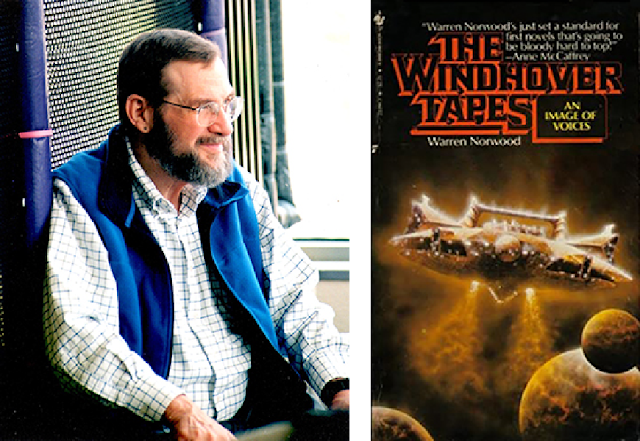
Warren C. Norwood, with the decidedly "retro future" cover of his first novel, "An Image of Voices."
Warren C. Norwood never loved the covers he got--but in 1982 a first-time novelist had no say over the images his publisher chose to slap on his books. In Jan's opinion, the best of the lot was the one at right--a stock cover they'd bought beforehand, based on nothing in the story. We hope to do better when we re-issue his books! (Photos courtesy of G.S. Norwood and Amazon.)


And yes, I have a couple of novels that date to the 1980s and 1990s, too. Both are science fiction, and both could stand to have a little zeerust brushed off and be touched up. Both came very close to being published "back in the day,"  but I have no current plans to revisit them. 

No, I'd rather stay focused on Rana Station and the XK9s, for now, thanks!

IMAGE CREDITS: Many thanks to CCNY Libraries, for the still from the movie Metropolis. The photos in the Lee Killough/Doppelgänger Gambit montage are courtesy of courtesy of James Nicoll Reviews, Amazon, and Books We Love. The beautiful reproduction of Frank Kelly Freas's masterful "The Ark of Mars" illustration is courtesy of Scanzen on Tumblr. The photo of Warren C. Norwood is courtesy G. S. Norwood. The cover image for An Image of Voices is courtesy of Amazon.