Showing posts with label racism. Show all posts

Wednesday, March 2, 2022

The First!

By Jan S. Gephardt

I’ve lived long enough to realize that, in this century, “the first” is always bittersweet.

Certainly, “The First Ever!” is exciting. There’s a sense of breakthrough, a sense of entering a new frontier, a new future in which the possibilities expanded. I remember The First American Woman in Space (Sally Ride). The First Woman Supreme Court Justice (Sandra Day O’Connor). The First Black President of the United States (Barack Obama).

I was one of the three million more people who cast our votes for The First Woman President of the United States. (Instead of the authoritarian loser con-man the Electoral College gave us). But these are all “firsts” that I, personally, in my lifetime remember. What went wrong with all the hundreds and thousands of years before that?
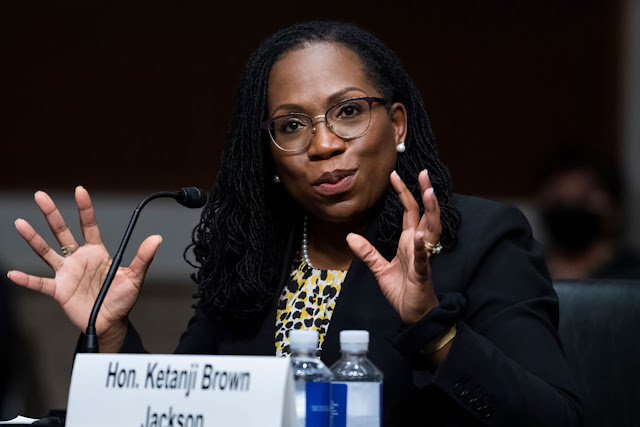

The Honorable Ketanji Brown Jackson testifies at an earlier confirmation hearing.
Ketanji Brown Jackson, nominee to be U.S. Circuit Judge for the District of Columbia Circuit, testifies during her Senate Judiciary Committee confirmation hearing in Dirksen Senate Office Building on April 28, 2021 in Washington, DC. The committee is holding the hearing on pending judicial nominations. (Photo by Tom Williams-Pool/Getty Images).


How Many Lost Opportunities?

In the flush of triumph over a brand-new “The First!” there are always a few inconvenient people. These folks fail to bask in the joy of the moment or celebrate an exhilarating milestone. Instead, they scowl and ask irritably, “What the hell took us so long?”

I have become one of those people.

I am delighted to greet President Biden's nomination of Ketanji Brown Jackson to the Supreme Court with applause. From what I’ve been able to learn about her, she’s perfect for the job. Especially when compared with certain recent previous nominees (currently serving), she’s vastly overqualified.

But nobody’s going to convince me she’s The-First-Ever-In-All-Of-History Black woman with the wisdom, discernment, and gravitas to be a Supreme Court Justice. How many others have there been in history, who – if given the chance, the education, and the opportunity – could have served as well or better than the ones we’ve had?


"So now the perception is, yes, women are here to stay. And when I'm sometimes asked when will there be enough [women on the Supreme Court]? And I say when there are nine, people are shocked. But there'd been nine men, and nobody's ever raised a question about that." - Ruth Bader Ginsburg
Nine female justices definitely would be an interesting reversal. (AZ Quotes).


232 Years. 120 Justices, 115 of Them Male and 117 White

A person would have to suffer from a titanic case of bigotry and misogyny to look at that header and not see prejudice. How, in all those 232 years, could mostly only white men be suitable – if not for a society weighted down and drowning in racial and gender bias?

I remember being exhilarated by Hillary Clinton’s so-called “cookie gaffe” in 1992, when she was on the campaign trail with Bill. "I suppose I could have stayed home and baked cookies and had teas, but what I decided to do was to fulfill my profession, which I entered before my husband was in public life," she said. Perhaps she did offend some stay-at-home moms (defensive, much?). As for me, I wanted to stand up and cheer.

Not because I have anything in particular against teas, cookies, or stay-at-home moms. In 1985 I became a stay-at-home mom, and I was one when she said that in ‘92. No, it was because back then there were a lot of people who made no bones about wanting women to “stay in their proper place” (read that: at home, with no public role, ever). Most of the folks who exerted that pressure were white men. Quite possibly, that’s because most of the people who got to have a say about things in those days (has it really changed that much?) were white men. But it’s certain that they preferred it that way.
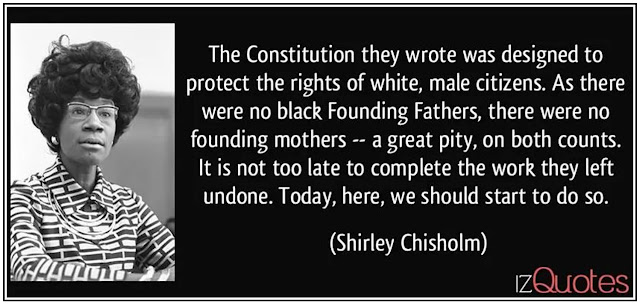

“The Constitution they wrote was designed to protect the rights of white, male citizens. As there were no Black Founding Fathers, there were no founding mothers – a great pity, on both counts. It is not too late to complete the work they left undone. Today, here, we should start to do so.” – Shirley Chisholm
The work she wanted to start “today” was creating the Equal Rights Amendment. It still hasn’t been ratified today. (IZ Quotes).


Lots of Oppression to Spread Around

During Women’s History Month, we often get a double-dose of “remember The First!” stories. They’re often couched as a courageous fight for equal rights, and they certainly were. If you doubt that, contemplate the life and struggles of Alice Paul, for just one example.

The stories of Women’s History Month, like the stories of just-ended Black History Month, are stories about struggles in the face of powerful oppression. This oppression has come from established societal norms and from laws. It has often been enforced with great brutality, against persons made helpless and defenseless by all the combined powers in the world around them.

But, especially in the case of women, the oppression often hasn’t been exerted by strangers or conquering foreigners. No, this pervasive oppression all too frequently has come from our own family members and our own intimate partners. The people with whom we’ve lived most closely and love dearly. They (and we, embedded in cultural norms) often haven’t even recognized it as oppression.

Perhaps our oppressors saw it as “protection.” Maybe they saw it as “sheltering.” They may even have seen it as “nurturing.” But “It’s for your own good” is the deepest cut of all, when you’re being held back, held down, and kept from achieving your full potential.


Some screen-captured results from Google searches for “the first woman . . .” and “the first Black . . .”
Here’s what “the Google test” turned up for these searches. (See credits below).


Try the Google Test

While I was preparing this post, I tried “the Google test.” That’s where I type in the beginning of a phrase and see what the algorithm fills in. It offers a glimpse of some commonly-searched-for topics, including things trending lately. Which is probably why, when I typed in “The first Latinx . . .” so many answers came back about the Oscars. I’ll admit I was kind of astonished to find that my search for “The first Black . . .” turned up zero references to female Supreme Court nominees, although we did get Thurgood Marshall in there.

My beloved United States has come up with a lot of forms of oppression in its history. I shouldn’t be shocked. But I always am a bit more saddened, when I remember yet another category-label variation of “human” that my fellow countrypersons have found it agreeable to oppress.
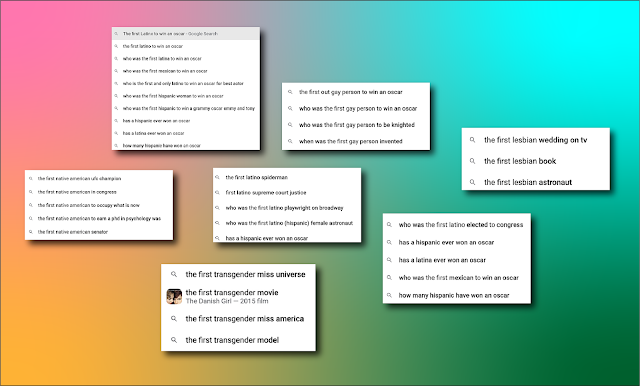

Some screen-captured results from Google searches for first Latinx, Native American, Asian-American, and LGBTQIA+ people.
More “Google tests” and more results. (See credits below).


The First of Any Distinguished Category

I hope that by now I’ve clarified what I mean when I say that, in this century, “the first” is always bittersweet. Whenever there’s a “The First!” of any distinguished category, that means there has been a whole world of hurt, degradation, and missed opportunities in the past. Oppression of some kind has deprived us of untold brilliant individuals until this first one now.

They could have improved our lives, expanded our minds, and brought their own unique power and possibility into the larger world. But oppression strangled their voices. It smothered their options, and murdered their visions. Oppression, like war, is a destroyer. But while war is flashier and louder, oppression is more pervasive. Like a miasma, it spreads everywhere and relentlessly kills the light.

When we live to see a “The First!” we do see a moment of hope, but it perhaps shines brighter because it shines out against a deep history of darkness, evil, and oppression. Every triumphant “The First!” is a marker that says, “oppression lingers here.” It’s bittersweet because it took so long and cost so much. And because we know that it’s not a “streak” yet. It might prove to be a solitary exception that the powers of oppression could turn into a token and use against further progress.

But we’ll take it, all the same. Because every “The First!” story is far, far better than the all-too-great multitude of “Never Yet in This World” laments.
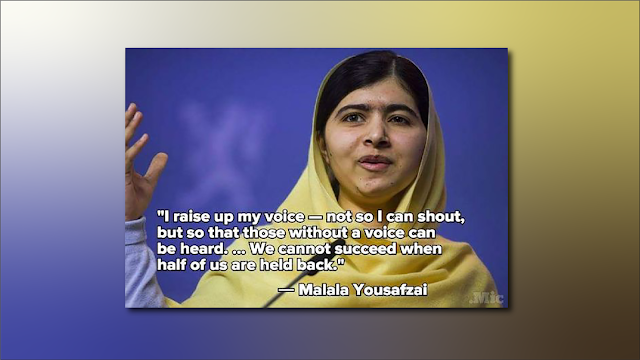

“I raise up my voice – not so I can shout, but so that those without a voice can be heard. . . . We cannot succeed when half of us are held back.” – Malala Yousafzai
Misogyny is very far from only being isolated to the United States. Here, at least educating girls isn’t controversial! (See credits below).


IMAGE CREDITS

Many thanks to Ohio Capital Journal, photographer Tom Williams-Pool and Getty Images, for the photo of the Honorable Ketanji Brown Jackson at a previous confirmation hearing. We’re grateful to AZ Quotes for the quote-image from Ruth Bader Ginsburg, and to IZ Quotes, for the quote from Shirley Chisholm.

We also must appreciate Google’s search engine for all the screen-captured search results. Jan S. Gephardt assembled and designed the montages. Finally, the quote from Malala Yousafzai comes courtesy of MIC Network, via Artdog Adventures. It was the “Artdog Quote of the Week” on March 5, 2018. Many thanks to all!

Wednesday, June 24, 2020

Rethinking policing for Rana Station

Rethinking policing has always been an important part of my world-building  for the futuristic world of my science fiction novels. Recent protests and calls to abolish or defund the police have given me fresh material to work with. 

But they haven't changed my plans for the series.

Jan S. Gephardt’s current “XK9” books are “The Other Side of Fear,” and “What’s Bred in the Bone.”
At the time this post went live, these were the "XK9 books" available. Cover art for The Other Side of Fear is © 2020 by Lucy A. Synk; Cover art for What's Bred in the Bone is © 2019 by Jody A. Lee.

Balancing reality and fiction


One of the joys of speculative fiction is that you get to make up your own world. That makes it possible to explore all sorts of thought experiments. How would this or that work out, if this or that other thing happened? The challenge that comes with the joy is making your world believable.

I wanted to combine my love of science fiction, dogs, and mystery stories into a science fiction series. 

But I couldn't assert spontaneously sapient, talking dogs (sure, that's believable . . . or is it?). No, they'd need to be engineered and equipped. Most people probably wouldn't do that for a pet. Contemporary smart dogs are already sometimes too smart for their own good. Plus it would be expensive, and take a long time. 

My fictional dogs needed a job that required the development. I already knew I wanted to write a mystery in this futuristic setting, so K9s--police dogs--were a natural choice. 

A German Shepherd places its paws on a computer keyboard in a police station office. The meme reads, "Saw bad man, bit same. End of Report."
They aren’t using computers yet, but dogs are smarter than we think. (GSCSafety/Donna Clayton/Pinterest)

I set my story on a space-based megastructure built on designs actual rocket scientists thought might work. My canine-cognition, robotics, and other research led me to other extrapolations. I hoped I'd figured it out so my readers could suspend their disbelief, and enjoy the story.

Reality and fiction in policing for Rana Station


But how to portray the police? I knew from the start that TV and movies were no guide. They tend to show cops as good-guy protagonists. They're frequently wildly erroneous. They often glorify, erase, or excuse terrible misconduct for the sake of drama. 

My original goal was to portray a style of policing that a real police officer could read and think, "yes, this is right. This is how it really works." 

Never having been a police officer or worked in that world, I had a lot of learning to do. But the more I've learned about the way it really works, the less I think it fits with the rest of how Rana Station is conceived. 

Several signs promote a growing push to defund and demilitarize the police.
The more I learned about how policing really works today in black and brown communities, the more I found myself in sympathy with concerns reflected in recent protests (Uncredited/The Hill)

The society on Rana Station is yet another thought experiment. This one is steeped in my roots as a teacher in urban schools. I built it on understandings from working on my Master's degree in Multicultural Education. As one of my characters says in a later chapter of What's Bred in the Bone, Rana's "governmental aim is to support the realization of each and every inhabitant-being's full potential."

The rest of the surrounding universe looks more like systems we're unfortunately familiar with. In some ways Ranans themselves don't live up to their ideals. In others, they do better. Part of the fun is speculating about what might happen when social systems, values, and priorities collide.

Rethinking crime 


One thing about humans: crimes happen. People screw up. They fight. Greed gets the best of them. Con artists run their scams. Passions rise, and sometimes people die. There are plenty of cases to solve, even on Rana Station. 

But a society built on respect for everyone, and dedicated to supporting their achieving full potential, isn't going to criminalize many of the things our society uses the police to address.

Members of the Pinellas Sheriff’s Department Forensics Team and St. Petersburg Police gather evidence at a murder scene in St. Petersburg, FL in 2017
When murders occur, they must be investigated. Members of the Pinellas Sheriff’s Department Forensics Team and St. Petersburg Police gather evidence at a murder scene in St. Petersburg, FL in 2017. (Uncredited/Tampa Bay Times)

Addiction isn't illegal on Rana Station. People can have small quantities of controlled substances. But authorities regulate potentially dangerous substances and try to stifle smuggling. Sapient-trafficking is illegal pretty much everywhere (but which beings are sapient?).

Digital thievery plagues everyone. Rana's "second-story men" (and women) sometimes intrude on residence towers. As in Chapter One of What's Bred in the Bone, people sometimes get mugged.

Assaults, rapes, and murders do still occur (although there are lots more conflict mediation efforts on Rana Station than in the USA right now).

And the XK9s, along with their human allies, are on the case.

Rethinking policing in more ways than one


But a social system designed to support every inhabitant-being reaching their full potential would not look like our reality. That means not only is the agriculture different. The schools are different. Ranan mental and physical health-care infrastructure is different (to name just a few).

And Ranan policing is different, too.

Today's "defund" advocates demand some changes that already were planned features on Rana Station. Even before our collective consciousness raising on police use of force. For instance, police won't be the first responders called for most mental health crises. Mental health professionals called "Listeners" will. Many current "de-criminalize" issues are handled outside of the justice system on Rana.

Police prepare to clear a camp set up by people experiencing homelessness in San Francisco, in 2017.
The criminalization of poverty reaches an extreme when it comes to people experiencing homelessness. Police prepare to clear a “homeless” camp in San Francisco, in 2017. (Judith Calson/San Francisco Public Press)

RReaders of What's Bred in the Bone may recall that the Orangeboro Police Department has a STAT Team (for "Special Tools and Techniques"). I originally called them a "SWAT" Team, but "Special Weapons and Tactics" recalls the old-fashioned militarized unit of contemporary practice. That's not what I intend to portray.

In very special circumstances some SWAT-like tactics may be needed. Think sharpshooters, or psychologist-trained negotiators. But Ranan STAT teams also embrace what we think of as search-and-rescue,  bomb squads and communications and surveillance specialists. They're known for saving lives, not kicking doors.


Rethinking police mental and physical health


One major area where my police research appalled me is the real world of police officer/first-responder stress. Rather than write in generalities, I'll share a summary of an all-too-typical case study. This one's from the March 2016 AA Grapevine, but unfortunately none of it seemed unusual, or out of step with other cases I've studied. 


Erika J.'s story

The writer was a young woman who'd wanted to be a police officer since she was in high school. Right at the start of her first rookie year she had a "suicide by cop" call. Although it was devastating, she felt compelled to "lie my butt off" to the department psychologist so she wouldn't lose her job. 

There are so many wrong things, just in that one element of her story.

From the beginning, this young employee understood if she was honest she'd be fired (like most people, she needed her job). She didn't feel supported, and that pattern continued. Later promoted to detective, she was "the only police officer in town assigned to juvenile cases." Not surprisingly, the caseload overwhelmed her. She asked for a reassignment after six years, unsure how many more autopsies of abused babies she could handle. Her request was denied.

So she "boarded out" and qualified for a promotion. Later, as a now-sergeant with a 3-month-old breastfeeding infant, they denied a reassignment that would make it easier to care for her baby. "I was told to quit whining and do my job." There's more. But if you're like me you've seen enough already. It's really not surprising this woman developed a problem with alcoholism. The way she was treated--by her brothers (and sisters?) in blue--ought to be criminal.

Mitchell, SD Police Officer Mici Bolgrean does paperwork.
Stress and feelings of isolation can build up for cops if they’re not given adequate support. Mitchell, SD Police Officer Mici Bolgrean does paperwork. Only 5% of South Dakota officers are female. (Sean Ryan/Republic)

So many wrong things


Instead, it's not uncommon. She probably got more grief because she was a woman (way to diversify, people!!). But male officers don't get much less pressure. That old-school police culture is toxic, no matter who's on the receiving end. As other pressures in society build virulence, police officer suicides have hit an upward trend.

Cops also work long hours with few breaks and little access to healthy food. That's why you see so many fat officers after they've been on the job for a while. They're usually not so much lazy as stressed-out and overextended. You won't be surprised that police officers are at 30-70% more risk of sudden cardiac arrest than others, when thrown into stressful situations.

It's not an acceptable reason, but it's easy to see how some officers grow jaded, callous, or abusive. That kind of job environment is practically a formula for inappropriately-displaced aggression. Give that human powder-keg a racist system to work in, a history of oppression and a gun, and you have a police brutality offense just looking for some "uppity" brown-skinned person to trigger it. 

Rethinking policing in a better way


Ranan culture doesn't put up with any of these ways of doing things. They are stupid, counter-productive, and deeply destructive. Excuse me while I'm "unrealistic," and explore a better way.

We need to ask why our own contemporary society puts up with those stupid, destructive ways of doing things. Must we abolish the police and start over from scratch to get rid of rampant, racist old-school police culture? If so, it might be a better way of rethinking policing than many people believe.

IMAGE CREDITS:

The covers of my books are from my Jan S. Gephardt’s Artdog Adventures website. Many thanks to Greater St. Cloud Public Safety Foundation, via Donna Clayton’s Pinterest Board, for the K9-making-a-report meme. I’m grateful to The Hill, for the photo of the “defund” protesters. Many thanks to the Tampa Bay Times for the photo of the murder scene investigation. I am grateful to Judith Calson of the San Francisco Public Press, for the photo of the police outside the "homeless camp." and thanks also to the Mitchell (SD) Republic and photographer Sean Ryan for the photo of Mitchell, SD Police Officer Mici Bolgrean at work. 
 

Wednesday, June 17, 2020

How (and why) might we defund police?

It appears that when people say, "Defund the Police!" they often don't mean completely. They usually appear not to mean "dismantle the police force and don't replace it," although some do. 
I started examining the ideas of abolishing or defunding the police in the previous post on this blog.

Defund the Police, like Abolish the Police, is an arresting (sorry), but inadequate slogan. Like most ideas, if you take the logic to its farthest extreme, it's a terrible idea (hint: for real-life applications, never go to the farthest extreme). But people have begun to have valuable discussions about the way forward.

This political cartoon by Kevin Sies shows two protesters with a very long banner full of many catch-phrases on police reform

Deciphering what they actually mean


In the simplest statements I've heard, the idea is to reallocate some funds from the local police department. Then to spend them building up departments that would be more appropriate responders to certain kinds of situations. Police solutions often end with someone arrested or ticketed, possibly taken to jail. That's appropriate for some things, but not for others.

For example, if it's a mental health crisis, deploy some kind of mental health equivalent of EMTs (and yes, I know we don't have those yet). This would radically reduce the number of incidents in which a mentally ill person in crisis (but mostly a danger only to themselves) isn't confronted, further agitated, and then eventually killed by police.

Another example we often hear cited is when police are called to deal with persons experiencing homelessness. What do these people need? Certainly a better place to live. Many also need mental health counseling, physical health care, possibly addiction treatment, additional education so they can find a job, or other services. What can police do about them? Usually none of those things. They can arrest them, or force them to go somewhere else. That's pretty much it.

A large, multi-spout teapot labeled "Defund the Police" pours tea into cups marked "education," "universal healthcare," "youth services," "housing," and "other community reinvestments."
(Illustration courtesy of Aleksey Weintraub, @LAKUTIS via Twitter)


Why many say policing itself needs a re-think


Diversity training is only as good as the trainer who teaches, and the personal investment of the people who show up. Until individual officers take the messages to heart--and until there's greater diversity and cross-cultural understanding in most police departments, cultural clashes will continue to fuel bad outcomes.


Even when radical overhauls happen, there's often still a gap between desire and result. It's discouraging. But allowing ourselves to feel defeated and saying, "I give up" isn't a sustainable solution. Sweeping problems (and problem officers) under the rug doesn't work. Perpetuating and doubling-down on "how we've always done things" doesn't cut it. We've been doing that for decades, and the results keep getting more extreme.

A city worker power-washes "Defund the Police" from the road outside the Atlanta Police Department, after the protests in Atlanta. When the protests subside, will calls for reform be as easy to erase or ignore? (Photo by Alyssa Pointer/Atlanta Journal-Constitution)

What is policing supposed to do?

It gets down to questioning the very purpose of policing. Why do we have police? To keep public order, so we feel safer in our neighborhoods? To respond to (or ideally limit/prevent) crimes such as murder, assault, rape, fraud, and similar invasions of property and person? 

Do they have a role in limiting vandalism, truancy, and roving bands of unoccupied youths, or should other programs address those ills?


De-criminalizing our society


Many proposals start with a laundry-list of things to de-criminalize. I've already mentioned de-criminalizing homelessness in this article. A strong case also can be made for de-criminalizing addiction and drug possession. 


De-criminalizing poverty is another consideration. We could do this in part by examining all proposed statutes, civil codes, and local ordinances to see which disproportionately afflict poor people. Another good starting place might be not over-policing poor and minority neighborhoods.

This cartoon by artist Barrie Maguire makes the point that de-criminalizing drug addiction would free up jail space.
Decriminalizing addiction, drug use and other "offenses" that could better be handled by other agencies would also free up jail space (Barrie Maguire cartoon courtesy of the Philadelpha Inquirer).

Where do we go from here?

Some"de-fund" arguments focus, not on policing itself, but on problems that perpetuate the conditions that encourage crime. 

Even before the pandemic threw them into glaring prominence, inequalities in educational opportunities, in health care, in food security and economic opportunity were major concerns. So it's not surprising inequities claim prominent places on many people's "to-reform" lists. Yet all of those things get less money from local governments than policing. Many cities' biggest budget item is its public safety budget.

Some observers fear we're rushing into things with half-baked approaches to revamping police forces or radically altering them. Others fear we'll only use half-measures, then reluctant politicians will have an "out" to declare, "well, that didn't work!" a few weeks or years from now.

But what if we were really serious about this? What if we actually tried a well-thought-out plan to readjust the way we do social well-being, including efforts to ensure law, order, and justice for everyone? For real.

I think we're all still trying to figure out how that would look. But next week in this space, I'll take a stab at relating my own vision and thoughts to my stories about policing in the future on Rana Station.

IMAGE CREDITS:

Many thanks to the Charlotte Observer/McClatchey, for the Kevin Siers cartoon. The "Defund the Police Teapot" illustration is from Aleksey Weintraub, @LAKUTIS via Twitter. It appears to be a clever adaptation of a photo of an actual, multi-spout teapot from Tea Exporter India (now a defunct link) via Alobha Exim's Pinterest board. The photo of the city worker power-washing the street in front of the Atlanta Police Department is by the formidable Alyssa Pointer of the Atlanta Journal-Constitution The remarkable Barrie Maguire (who also did a stint at Kansas City's own Hallmark) is a marvelous fine-art painter of Irish-inspired work, but he also created cartoons for the Philadelphia Inquirer for a while, including this one dramatizing prison overcrowding.

Monday, March 16, 2020

Owning our "own voices"

The Artdog Quote(s) of the Week


Who owns our voices? If you run in the circles I do, you're aware of the "own voices" movement, which has been growing since 2015. It started in children's books, but it's reaching far beyond that now, because it's a sound idea.

In simplest terms, as Blue Crow Publishing lays it out, "'Own voices' means that if you are writing a main character who is part of marginalized group, you are part of that marginalized group."

(image quote courtesy of a tumblr that no longer exists, via Pinterest)

It's a simple, elegant, empowering idea


For so many, many years, marginalized voices went unheard. Drawing on Blue Crow's explanation above, if, for example, you were a trans* person writing about a trans* main character in the past, you wouldn't even be able to get published at all.  The gatekeepers were all white cis folk who didn't have a clue about the issues, drama, and authentic visions of trans* persons.

Heck, most of the traditional media still have a problem letting more marginalized voices speak up. Remember #Oscarssowhite? That was a few years ago (2015), but it seems the lessons keep on having to be re-learned.

Sorry to all the wishful thinkers. No, we are not yet "post-racial." We have a long, long, long way to go, before we get there.

I remain convinced that until the rise of indie publishing, and the success of niche markets such as gay erotica (which doesn't even seem so "niche" any more), we would have seen the "own voices" movement rise even more slowly.


(Photo from the Huffington Post)


Why are authentic "own voices" needed?


Environmental science, biology, history, business experience, and common sense all teach us the same lesson. A diverse community brings a variety of strengths to the table. More approaches. More interesting meetings of minds and cultures and perspectives. Diverse communities are stronger and more adaptable. Yet humans' instinct for tribalism fights this truth.

Likewise, intellectual communities are more adaptable, versatile, and robust when they accept many inputs. Our own individual world-views are deepened and enhanced by knowledge of wider ranges of possibility. When we pay attention to writers who tell their own stories and speak in their own voices, our understandings expand.

I recently blogged on my publisher's website about the book American Dirt, and the need to read works by people who really know what they're writing about. Such accounts tend (when well-written) to be more powerful and more realistic. And interesting.

(Photo from the Huffington Post).

IMAGE CREDITS:


Many thanks to a tumblr that no longer appears to exist, via Pinterest, for the Rosario Dawson image-quote. I also thank The Huffington Post, which published the features that provided two of these posts. They are "18 Times Black Actors Nailed Why We Need Representation in Film," and its sidebar slide show (scroll to the bottom), "16 Times Latinos Were Brutally Honest about Hollywood's Lack of Diversity." 


Monday, February 12, 2018