Showing posts with label racial equality. Show all posts

Wednesday, June 17, 2020

How (and why) might we defund police?

It appears that when people say, "Defund the Police!" they often don't mean completely. They usually appear not to mean "dismantle the police force and don't replace it," although some do. 
I started examining the ideas of abolishing or defunding the police in the previous post on this blog.

Defund the Police, like Abolish the Police, is an arresting (sorry), but inadequate slogan. Like most ideas, if you take the logic to its farthest extreme, it's a terrible idea (hint: for real-life applications, never go to the farthest extreme). But people have begun to have valuable discussions about the way forward.

This political cartoon by Kevin Sies shows two protesters with a very long banner full of many catch-phrases on police reform

Deciphering what they actually mean


In the simplest statements I've heard, the idea is to reallocate some funds from the local police department. Then to spend them building up departments that would be more appropriate responders to certain kinds of situations. Police solutions often end with someone arrested or ticketed, possibly taken to jail. That's appropriate for some things, but not for others.

For example, if it's a mental health crisis, deploy some kind of mental health equivalent of EMTs (and yes, I know we don't have those yet). This would radically reduce the number of incidents in which a mentally ill person in crisis (but mostly a danger only to themselves) isn't confronted, further agitated, and then eventually killed by police.

Another example we often hear cited is when police are called to deal with persons experiencing homelessness. What do these people need? Certainly a better place to live. Many also need mental health counseling, physical health care, possibly addiction treatment, additional education so they can find a job, or other services. What can police do about them? Usually none of those things. They can arrest them, or force them to go somewhere else. That's pretty much it.

A large, multi-spout teapot labeled "Defund the Police" pours tea into cups marked "education," "universal healthcare," "youth services," "housing," and "other community reinvestments."
(Illustration courtesy of Aleksey Weintraub, @LAKUTIS via Twitter)


Why many say policing itself needs a re-think


Diversity training is only as good as the trainer who teaches, and the personal investment of the people who show up. Until individual officers take the messages to heart--and until there's greater diversity and cross-cultural understanding in most police departments, cultural clashes will continue to fuel bad outcomes.


Even when radical overhauls happen, there's often still a gap between desire and result. It's discouraging. But allowing ourselves to feel defeated and saying, "I give up" isn't a sustainable solution. Sweeping problems (and problem officers) under the rug doesn't work. Perpetuating and doubling-down on "how we've always done things" doesn't cut it. We've been doing that for decades, and the results keep getting more extreme.

A city worker power-washes "Defund the Police" from the road outside the Atlanta Police Department, after the protests in Atlanta. When the protests subside, will calls for reform be as easy to erase or ignore? (Photo by Alyssa Pointer/Atlanta Journal-Constitution)

What is policing supposed to do?

It gets down to questioning the very purpose of policing. Why do we have police? To keep public order, so we feel safer in our neighborhoods? To respond to (or ideally limit/prevent) crimes such as murder, assault, rape, fraud, and similar invasions of property and person? 

Do they have a role in limiting vandalism, truancy, and roving bands of unoccupied youths, or should other programs address those ills?


De-criminalizing our society


Many proposals start with a laundry-list of things to de-criminalize. I've already mentioned de-criminalizing homelessness in this article. A strong case also can be made for de-criminalizing addiction and drug possession. 


De-criminalizing poverty is another consideration. We could do this in part by examining all proposed statutes, civil codes, and local ordinances to see which disproportionately afflict poor people. Another good starting place might be not over-policing poor and minority neighborhoods.

This cartoon by artist Barrie Maguire makes the point that de-criminalizing drug addiction would free up jail space.
Decriminalizing addiction, drug use and other "offenses" that could better be handled by other agencies would also free up jail space (Barrie Maguire cartoon courtesy of the Philadelpha Inquirer).

Where do we go from here?

Some"de-fund" arguments focus, not on policing itself, but on problems that perpetuate the conditions that encourage crime. 

Even before the pandemic threw them into glaring prominence, inequalities in educational opportunities, in health care, in food security and economic opportunity were major concerns. So it's not surprising inequities claim prominent places on many people's "to-reform" lists. Yet all of those things get less money from local governments than policing. Many cities' biggest budget item is its public safety budget.

Some observers fear we're rushing into things with half-baked approaches to revamping police forces or radically altering them. Others fear we'll only use half-measures, then reluctant politicians will have an "out" to declare, "well, that didn't work!" a few weeks or years from now.

But what if we were really serious about this? What if we actually tried a well-thought-out plan to readjust the way we do social well-being, including efforts to ensure law, order, and justice for everyone? For real.

I think we're all still trying to figure out how that would look. But next week in this space, I'll take a stab at relating my own vision and thoughts to my stories about policing in the future on Rana Station.

IMAGE CREDITS:

Many thanks to the Charlotte Observer/McClatchey, for the Kevin Siers cartoon. The "Defund the Police Teapot" illustration is from Aleksey Weintraub, @LAKUTIS via Twitter. It appears to be a clever adaptation of a photo of an actual, multi-spout teapot from Tea Exporter India (now a defunct link) via Alobha Exim's Pinterest board. The photo of the city worker power-washing the street in front of the Atlanta Police Department is by the formidable Alyssa Pointer of the Atlanta Journal-Constitution The remarkable Barrie Maguire (who also did a stint at Kansas City's own Hallmark) is a marvelous fine-art painter of Irish-inspired work, but he also created cartoons for the Philadelphia Inquirer for a while, including this one dramatizing prison overcrowding.

Wednesday, June 3, 2020

Crossing the line

The phrase "crossing the line" has a special resonance for me today. 

Crossing a deadly line


Like many metro areas in the United States over the recent weekend, mine saw day after day of large, mostly peaceful crowds demonstrating in the streets. The protesters came out to decry the actions of four Minneapolis police officers who slowly (it took almost nine minutes), publicly, murdered a man in the street by kneeling on his neck and back. 

Protesters hold signs and give speeches at a march for justice in Kansas City
Nareen Stokes, mother of Ryan Stokes, a local man killed by police, speaks to the then-peaceful crowd in Mill Creek Park near the Kansas City Country Club Plaza. (Photo by Carlos Moreno. Many thanks to KCUR Kansas City).


That's a deadly example of "crossing the line" that should never, ever be condoned. But that kind of "crossing the line"--extra-rough treatment of people from certain neighborhoods, with a certain skin color--by police happens all too often. 

Is there a systemic racism problem, or is it just a whole lot of unfortunate, isolated incidents? How you answer that question probably depends on your background, experiences and race. There's even disagreement among police. Black officers see more of a problem than white officers, in recent polling.

Certainly, the officers in the George Floyd case crossed a line, although getting charges and convictions will be difficult. This wasn't the first time Officer Derek Chauvin, the neck-kneeler, got in trouble for mistreating citizens, although one hopes it is the last.

Why do police officers cross those ethical lines? 


Anyone who has followed my blog for any length of time knows I'm not a hater of the police. I'm concerned about their well-being, inspired by their service, and generally convinced that we'd be in a world of hurt without them. I write novels about (mostly) admirable law enforcement officers, and I do my level best to extrapolate realistically into my futuristic world.

But people are people. While most applicants go into law enforcement with good motives, no profession is populated solely by angels. And although many seek an exciting career, police work may be more than they bargained for. The job gives officers a front-row seat on more trauma and ugliness than most civilians would see in several dozen lifetimes.

A poster available on Amazon lists danger signs of officer stress
A poster available on Amazon lists danger signs of officer stress, and management cues. (image courtesy of Police Posters on Amazon).


Wounded, traumatized people can grow callous or violent. A persistent old-school police culture further tends to ignore the advice of psychologists about dealing with stress. Instead, there's pressure to "suck it up" and get on with the job. To self-medicate for depression or stress with alcohol or other substances. Nobody does their best work while drugged.

Crossing other lines


Unfortunately, I need to get back to those protests I mentioned at the beginning of this piece. Because although during the day most protesters peacefully exercised their First Amendment rights, things changed at night. 

Night after night, rioters have vandalized, looted, and burned businesses and cars. It happened here in Kansas City, and in many other cities, too. One shocking casualty that hit the science fiction community extra-hard was the loss of the legendary Uncle Hugo's Science Fiction Bookstore in Minneapolis.

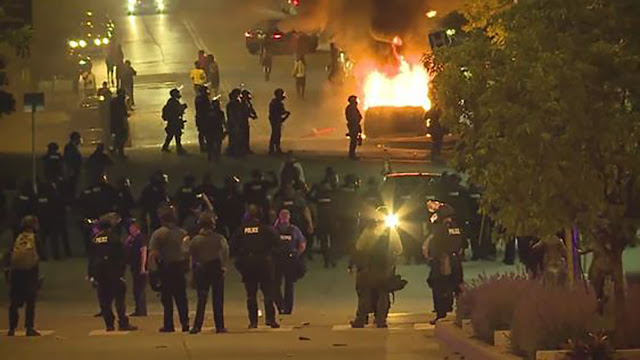
It's as if the transition from day to night turned people mean. In part, it seemed to become a self-fulfilling cycle. Authorities imposed curfews, in an effort to prevent violence. Police attempted to disperse crowds, in many cases using tear gas or pepper spray. Angry protesters fought back, and all hell broke loose.

After dark, the protests turned uglier. A Kansas City PD vehicle burns on Saturday night.
After dark, the protests turned uglier. A Kansas City PD vehicle burns on Saturday night, May 30, 2020.
(Many thanks to Fox 4 News for this photo).


A better kind of line-crossing


But I'd like to close this post on a brighter note. For all the anger on display, for all the ugliness after nightfall, and for all the brutality being protested, there were moments of positive "line-crossing." Of police officers taking a knee, joining a march, and reaching across barricades. And there were more of them than I recall having seen in past rounds of protests.

They, too, were mostly appalled at the way George Floyd died. Police forces in most of our cities are engaged in a long, slow effort to reform relations with their communities of color. There are a lot of fences to mend. A lot of history to overcome. That's why people are in the streets--again. Too many times, police officers have crossed that line in the wrong ways.

At left two Kansas City PD officers hold up a sign that reads, "End police brutality!" At right KCPD Chief Rick Smith and Kansas City Mayor Quinton Lucas kneel for a moment of silence for George Floyd, while holding up an "I can't breathe" T-shirt
Possible signs of change in Kansas City? At left two Kansas City PD officers hold up a sign that reads, "End police brutality!" At right KCPD Chief Rick Smith and Kansas City Mayor Quinton Lucas kneel for a moment of silence for George Floyd, while holding up an "I can't breathe" T-shirt. (Photos courtesy of Forbes, via Twitter and Katie Moore/Kansas City Star).


That needs to change. Our communities are calling for it. Police departments surely know it can't continue this way, and some places appear to be doing better. 

Let's nurture that change. Let's find ways to encourage and reinforce it. It's time for crossing the line of division, and reaching out toward healing.

IMAGE CREDITS

Many thanks to KCUR Kansas City and photographer Carlos Moreno, for the photo from Nareen Stokes's speech. Police stress poster image courtesy of Police Posters on Amazon. Many thanks to Fox 4 News for the photo from Saturday night. Photos of connections between police and community are courtesy of Forbes, via Twitter and Katie Moore/Kansas City Star. I appreciate all of you!


Monday, February 3, 2020

Nothing is simple

Nothing is simple, although it may look that way from the outside.

I found an article the other day in one of my online research resources, Police Magazine. It reported on a disturbance in New York City's Grand Central subway station. 

A group called Decolonize this Place organized it as part of a daylong series of demonstrations. This is the third time this group has staged demonstrations since earlier in 2019.

A still from a video from New York Post, via Police Magazine, showing the protest in the terminal. (Police Magazine/New York Post)

They didn't manage to close it down, as they'd hoped.

What they did manage to do was get national TV and other news coverage, and slow things down in Midtown. Reports on the size of the crowd and number of arrests varied. They left banners and sprayed graffiti, and tweeted about it. And they made an effort to look both intimidating and impossible to identify. Seems pretty obvious this group is up to no good, right?

Well, nothing is simple.

What's the goal of the disruption?

Photo from 1010 WINS Radio, via Twitter. (Note the
linked Twitter video contains profanity).
Let's unpack this. First of all, "end all policing" is connected to "destruction of public order." 

The goal is "to bring public safety back to NYC."

While the article in Police Magazine did list their goals as "no cops in the MTA, free transit [and] no harassment, " they focused more on the disruption and vandalism. 

That's not surprising. Their aim, as stated by MTA Chief Safety Officer Pat Warren (quoted in the article), is to protect "transit services that get New Yorkers to their jobs, schools, doctors and other places they need to go." Simple enough.

But nothing is simple.

How can the protests promote the need for public safety?


I'd just read another article about a UK study that demonstrated a 14-21% reduction in crime when the police patrolled subway stations every 15 minutes. These platforms previously had not had a police presence--exactly what the New York demonstrators are demanding.

The article even went so far as to make a direct comparison: "London’s Underground, akin to NYC’s subway system, was the first underground railway in the world, and now services more than 1.3 billion passengers per year."

The police show up and crime goes down. That's pretty simple, isn't it? But nothing is simple.

A study showed police patrols every 15 minutes in the London Underground deterred crime. Yet Decolonize this Place is demanding that police stop patrolling the New York City subways. Does this make sense? (Photo courtesy of Forensic).

 
Who's protecting whom, and from what?


The London Underground recently has seen delays from demonstrations, too, but those were staged by climate activists seeking attention. One of the biggest worries there seems to be terrorist attacks (and with good reason).

But hardly any of the London Underground's users seem to think the police themselves are a danger to public safety. No so, for Decolonize this Place. They demonstrated to remove them from the subways entirely. 

The New York City subway system's police officers, interacting with an assortment of low-income persons of color have been captured in distressing videos that went viral. This apparently happens frequently in the subways. 
The MTA recently (and controversially) hired 500 new officers to patrol the subways. They are there to address "quality of life" issues, such as illegal food vendors and the growing number of homeless people living in the subway system. 

Meanwhile, the NYPD has been cracking down on low-level crimes, and that's no surprise, since that kind of crime is up. But that often means focusing on persons of color, whether it's because of simple economics or racial bias. But addressing those issues, no matter how tactfully, is no simple matter.

Respect is not as simple a matter as it may seem. 


1981 Brixton Riots in the UK: first large-scale clash
between low-income black youths and white British
police in the 20th Century. (Photo from The
Royal Gazette
)
As far as I can tell, one clear problem with NYPD and MTA officers' approach is that it never seems to be respectful. Defensive, definitely--and in the current environment, caution is warranted.

But whatever their intentions, the effect when they surround a tiny, elderly churro vender with four or five much taller armed police officers and handcuff her is pretty darned intimidating.

This is not a new thing, this antagonism between police forces and the working poor. And it's not isolated to New York City. Fines that unfairly burdened lower-income residents of Ferguson MO fueled some of the fury in the wake of Michael Brown's killing. And all too often cities' attempts to "deal with the homeless problem" turn into efforts to chase the homeless out of town--or at least out of sight.

Officials used heavy equipment to clear out a homeless camp near Moncton, New Brunswick last May (photo by Shane Magee/CBC)

Even efforts designed to be helpful don't always succeed. Many places create task forces that include social workers to coordinate with the police, but their success is mixed. "Neighborhood policing" doesn't always have the desired result.

It's not just the working poor who feel disrespected. Police officers also have every reason to feel they are not respected. Indeed, too often they are violently targeted. "Bad actors" among sworn-officer ranks get sensational headlines, and besmirch the ones who honestly struggle each day to serve their communities.

Nothing is simple. Especially not efforts to negotiate the delicate balance of respect, accountability, and public order that characterizes interactions between the police and the working poor.

But it's quite simply true that everyone's safety and security depends on finding a way.

IMAGE CREDITS: 
Many thanks to Police Magazine (and New York Post) for the coverage of the protest, and to 1010 WINS Radio and Twitter for the tweet from Decolonize this Place. I'd also like to thank Forensic for the photo from the London Underground, and ABC-7 News for the screencap of homeless people in subways. Additionally,  much gratitude to The Royal Gazette for the historic photo from the Brixton Riots, as well as The Canadian Broadcasting Company (CBC) and their photographer/reporter Shane Magee for the photo from the Moncton NB homeless camp.

Monday, January 20, 2020

How should we honor Dr. King's legacy?

The Rev. Dr. Martin Luther King, Jr. was gunned down almost 52 years ago. Depending on where we live, we've been observing the holiday that honors him for 34 years, as of today. There are wide variations in the ways people observe (or don't pay much heed to) this holiday. But really. How should we honor Dr. King's legacy?

King's words ring as true now as ever. Senators, are you listening? (Image courtesy of PassportCamps)

What did Dr. King stand for?


And more of a socialist and anti-war activist than many in America wanted to accept (neither then, nor, in many ways, still today). He was subject to bouts of depression. Not always "liberated" in terms of women's equality. In other words, he was human. Complicated. Flawed. 

(Image courtesy of QuotesGram)
We shouldn't be surprised. Nobody's an icon in real life. But in light of his complicated nature, how should we honor Dr. King's legacy? I'd say the key is looking to his core values--the ideals he returned to again and again in his life. These are racial equality, as well as his work against poverty (which fueled his socialist thought) and war (noted for his devotion to nonviolence, he also spoke out strongly against the Vietnam War).

Racial equality


How should we honor Dr. King's legacy? Well, first of all, we can stand up against hate in our own personal lives.

White folks, we have a big responsibility in this area. To start with, we need to about the diversity within our own communities. Refuse to listen in appalled silence or titter weakly when someone cracks a racist joke or makes a racially insensitive comment.

Educate ourselves about white privilege, institutional racism, and the many ways that microaggressions and cultural appropriation wound and inhibit others. That's base-level, elementary stuff.

Beyond that, we white folks need to consciously expand our lives and our circles. Welcome and support persons of color in our workplaces, our places of worship, and our associations. Read the work of diverse writers (buy their books!)

Voting Rights go hand-in-hand with racial equality

One of the hardest-fought campaigns of the civil rights era was the effort to achieve equal voting rights for African Americans. The white supremacists who held a lock on the portals of power in those days would literally kill to prevent black people from voting (the contrast with King's nonviolent approach was part of what made the Civil Rights Movement so moving to people all over the world).

(Image courtesy of Medium)

We live in another era when voting rights--especially voting rights for persons of color--are under heavy attack. Between voter-roll purges, gerrymandering, ID requirements, and other shenanigans designed to disadvantage the poor, there is lots of corruption to fight. It will take advocacy by everyone to fight it!

How should we honor Dr. King's legacy?

Concrete steps we can take? Support voting rights for all. That includes felons who've done their time. Black communities have been decimated by a prison-industrial complex. Their lobbyists and lawmakers who want to be seen as "tough on crime" developed a system that unfairly targets impoverished (mostly black) communities.

Voting rights were a key goal of the civil rights movement. They're still highly relevant today! Advocate to your legislators. Support the League of Women Voters. And for pity's sake, vote yourself, to elect candidates and causes that support equality!

Poverty

Dr. King was fighting poverty by supporting the Poor People's Campaign when he was assassinated. But poverty is at least as institutionally entrenched now as it was then.

Even King himself (a college-educated member of the black middle class) was originally unaware of how profound poverty could be in the US, until he visited a black school in an impoverished rural community in the Mississippi Delta. There he saw the results of food insecurity for himself. He was, in the Christian sense, convicted by what he saw. From that time forward he held a special place in his heart for the poor.

King observed many systemic forces trapping people in poverty, even when they strove to prosper (Image courtesy of United Way of Southeast Missouri).

He developed a burning sense of the injustice of the system. Conservatives then as today speak of "personal responsibility." They see it as primary in determining someone's prosperity or poverty. To King, this is a flawed analysis.

He argued for changes to the system itself. In the latter part of his life, King increasingly saw the problem of poverty as an inescapable failing that is intrinsic to any capitalist economic system.

King's work against poverty likely fueled his interest in socialism, which dates back at least to his studies at Crozer Theological Seminary and his study of the work of Walter Rauschenbusch. (Times Live, South Africa)

King's embrace of socialism

During the 1960s, the US reached the height of the Cold War with the Soviets, and plowed deeper into the Vietnam War against communism (more on that later).

Within a decade or so of Senator Joseph McCarthy's campaign to root out what he saw as a communist infiltration of the USA, socialism was deeply unpopular. Dr. King's embrace of it and his antipathy to the Vietnam War meant he was seriously unpopular in much of America at the time of his death.

Socialism remains "a dirty word" today in some quarters, but half a century after King died, some segments of the economy see it as an interesting proposition.

(Image courtesy of Medium)
The more progressive wing of the Democratic Party has fielded several candidates who embrace socialistic economic strategies, including Bernie Sanders, who labels himself a "democratic socialist," and another who espouses a basic minimum income. Andrew Yang calls it the "Freedom Dividend."

How should we honor Dr. King's legacy? Whatever your opinions on the best ways to combat poverty, it's certainly true that advocacy, donations, and volunteerism to aid the poor are always needed.

War

Aside from his socialist bent, King's opposition to the Vietnam War earned him a lot of enemies. Given his commitment to nonviolence his opposition should surprise no one. And with the hindsight of history we can see that he made some good points, although some might not accept his assertion that “we have no honorable intentions in Vietnam.”

No stranger to opposition, Dr. King followed his convictions on the Vietnam War, despite the cost to his reputation. (Image courtesy of PassportCamps)

But have you done a serious review of the decisions, assumptions and motivations that led our nation's leaders into that war? Unfortunately, it bolsters his opinion that “we have been wrong from the beginning of our adventure in Vietnam.”

Testing weapons on civilians? Unfortunately, yes.

He also was right that the US was testing weapons on the Vietnamese people. The Vietnam War became an ugly arena for the widespread use of chemical weapons. CS gas was deployed to drive combatants out of tunnels, but they often asphyxiated or were left with lesions on their lungs.

Agent Orange had been used as a defoliant before Vietnam, but never so widely as a weapon. The US contaminated almost a quarter of South Vietnam with the stuff, which decays into dioxin, a persistent carcinogen. The environmental and human destruction persist to this day.

While napalm had been used in a limited way during World War II and the Korean War, it was widely deployed against both Vietnamese civilians and Vietcong fighters. Although President Nixon later tried to convince the US public that napalm wasn't being used on civilians, there were too many journalists in-country, and too much of it was dumped over too broad an area to support that lie.
King's opposition to the Vietnam War won him little favor. (Image courtesy of Veterans for Peace)
The most horrifying weapons-test of the Vietnam War era never happened, however: a Defense Department consultant group discouraged testing the use of tactical nuclear weapons in Vietnam strongly enough that the idea was (thank goodness!) scrubbed.

How should we honor Dr. King's legacy? In my opinion, we all have an obligation to advocate for diplomacy over strutting arrogance and saber-rattling. Ways to promote peace? Contact your legislators. Demonstrate, if you're so inclined and have the opportunity. Vote for rational candidates who take a measured approach to conflict resolution.

It's also important to remember that peace begins at home. In our families and in our communities, intelligent communication and our commitment to de-escalation of violence (including violent words) sets a peace-friendly tone.

How should we honor Dr. King's legacy?

There are many ways to honor King's life and work. I think one of the best is by remembering what a complex, courageous, and deep-thinking person he was. His memory endures in part from the brilliance of his writing and the complexities and deep morality that drove him.

He can't be reduced to a symbol of just one thing, if we're honest. And there's no telling how differently we would remember him, if he hadn't been killed in the middle of his work.

He didn't get there with us. Indeed, we're still a long way from getting there. But the hope in his vision and the power of his courage offer ideas about how we should honor Dr. King's legacy. (Image by Heidi Yosinski/Penn State News, via Laura Schulenberg Cole)
IMAGE CREDITS: Many thanks to Passport Camps, for the "measure of a man"and "do what is right" quote images. I appreciate the Sunday Times of South Africa for the "necessities from the many" quote image, and QuotesGram, for the "valley of segregation" quote image. Thanks are due to Medium, for the "power of the vote" and "guaranteed income" quote images; to Veterans for Peace, for the "purveyor of violence" quote image, and to design student Heidi Yosinski, Penn State, and Laura Schulenberg Cole for the "mountaintop" quote image. I'm indebted to you all!