Showing posts with label equity and social justice. Show all posts

Thursday, July 2, 2020

Freedom of Religion: Is the First Amendment an aspiration, or reality?

Freedom of Religion: do we really have it? During our passage from Juneteenth to the Fourth of July this year, I’ve been thinking a lot about the First Amendment to the U.S. Constitution’s Bill of Rights. And especially the specific freedoms it enshrines.


The “Defund or Abolish the Police” movement has driven me (along with many others) to take some long, hard looks at the institution of policing, its history, and what it could become, if remade in a better way.


But—also in light of recent events—I’ve begun to wonder: Is the First Amendment just as aspirational as the police motto “To Protect and Serve”? In this and several future posts, I’ll consider our ideals, and how they add up next to our reality.


The text of the First Amendment to the US Constitution reads: “Congress shall make no law respecting an establishment of religion, or prohibiting the free exercise thereof; or abridging the freedom of speech, or of the press; or the right of the people peaceably to assemble, and to petition the Government for a redress of grievances.”
Many thanks to Indivisible of Door County, WI


Freedom of Religion


Today’s post interrogates the first sentence in the First Amendment (not using the Reid Technique).


“Congress shall make no law respecting an establishment of religion, or prohibiting the free exercise thereof,” is how the First Amendment begins. Yet, for much of our history, Americans have—and still do—strenuously seek to limit, abridge, and deny the religious freedom of others.


Superimposed over a painting of Franklin, Adams, and Jefferson working on a document are the words: "We've just created the separation of Church and State. It's so simple, a child can understand it. Right?"
Many thanks to Imgflip and Marshal Tenner Winter for this image.
 

Black people

Since well before the birth of the United States as a country Black people were enslaved in North America. Freedom of religion was one of the many freedoms they were denied.


But most owners insisted they be converted to make them see their enslaved state as God’s law. Some even altered the Bibles they allowed their slaves to have—they feared the Exodus story might give them too many ideas.


It didn’t ultimately work. The Black Church became a powerful force for freedom. But those slaveowners and their enablers gave religious suppression a real good shot. And they successfully stamped out a lot of African beliefs, or forced them to “go underground.”


This quote from Thomas Paine reads, ““Spiritual freedom is the root of political liberty...As the union between spiritual freedom and political liberty seems nearly inseparable, it is our duty to defend both.”
Many thanks to Ammo.Com.


Native Americans

The American authorities made far fewer bones about suppressing Native American spiritual and religious beliefs. "Freedom of religion for Indians" was never a consideration, even well into recent times.


They didn’t go about it quite like European invaders in what would be Mexican territories. Those “missionaries” enslaved and forcefully converted the Indians under their control.


But the US Government focused increasingly virulent ethnic cleansing energy on “pagan” ceremonies, starting in the 1830s. They made many practices illegal, punishable by imprisonment. 


They often forcibly kidnapped children and held them in boarding schools where their home languages, customs, and spirituality were brutally suppressed. This continued well into the 20th Century.


This graphic design by Mark Forton, based on the US flag, features symbols of many major religions in the "star field" with the words "Religious Freedom Makes America Great" below.
Right on, designer Mark Forton! This image is available on several products.


Contemporary hate and intolerance

More recently, white supremacists have felt free to attack churches, synagogues, and temples. Using domestic terrorism to suppress religious diversity flies in the face of the First Amendment, but law enforcement usually has focused on the egregious violence to persons and property. I wrote about this last year on my Artdog Adventures blog.

Lawmakers have tried and sometimes succeeded to use Christianity as an excuse to discriminate against LGBTQIA+ individuals, in what future generations may view as a violation of the "establishment clause."

The organization Human Rights Watch published a US map in 2018 that highlighted states with what it called "License to Discriminate" Laws, attacking LGBTQIA+ rights in the areas of adoption and foster care, counseling, and more. The states are: North Dakota, South Dakota, Michigan, Virginia, Tennessee, Alabama, Mississippi, and Texas.
Many thanks to Human Rights Watch for this map.


Some people welcome these laws and court rulings as "freedom of religion." But many others see them as "freedom to discriminate."


And unfortunately the current President of the United States seems determined to violate the full spectrum of First Amendment. He got started right away on freedom of religion.


Early his first year, he tried to keep Muslims from several countries out of the U.S. And eventually he succeeded. Does he value the appearances and trappings of religion far more than the substance? Looks that way to this writer.


How far have we really come?

We like to think that, as a nation, we've come a long way forward into a more equitable and enlightened society. We earnestly want to believe Dr. Martin Luther King Jr.'s words, "The arc of the moral universe is long, but it bends toward justice."


But recent events have laid bare just how deeply our country is divided. We disagree more sharply than ever on liberal/conservative lines. This has even gotten to the point where we disagree over simple public safety measures.


Savage injustices tear us apart on many other fronts, too. Economic equality. Access to health care. Our dealings with the justice system. And many more. So of course the intolerance issues extend to freedom of religion.


The challenge before us is clear. If we want that arc to bend toward justice, we must work to make sure it heads that way.


IMAGE CREDITS:

Many thanks to Indivisible of Door County, WI, for the text-image of the First Amendment. I want to thank Imgflip and Marshal Tenner Winter for the "So simple a child can understand" image. Much gratitude to Ammo.Com, for the Thomas Paine quote. And many thanks to Human Rights Watch for the "License to Discriminate" map. I appreciate you all!


Wednesday, June 10, 2020

Abolish the police?

If we abolish the police in the 21st Century, why should people need XK9s in the future? 

Wait! That wasn't the question at the top of your mind?
Here are the covers of the two books Jan had out in June 2020, "The Other Side of Fear," and "What's Bred in the Bone."
Learn more about Jan's XK9 Books on her website. She writes science fiction police procedurals about sapient police dogs on a space station. Cover artwork for The Other Side of Fear is © 2020 by Lucy A. SynkCover artwork for What’s Bred in the Bone is © 2019 by Jody A. Lee

Actually, it wasn't my first question, either (although I do have answers). When I originally learned about the movement to abolish the police, my first question was why would we do that? 

Then I realized that by asking that question I had already marked myself as a person who owns property and benefits from white privilege

Clearly, there was a disconnect happening. I needed to remedy it by educating myself.

Why would we abolish the police?


Let's start with my "Why would we abolish the police?" question. The answer depends on why the questioner thinks the police exist. Well, their motto is "to protect and serve." But protect what? Serve whom? That's where it starts to get dicey

This meme shows police violently throwing a protester on the ground. The superimposed words read "Protect and serve Yer doin it wrong"
(Meme courtesy of Cheezeburger.)


Functionally, throughout their history police forces have existed to protect the property and persons of some of the people from basically everyone else (except when they don't protect property or the personal safety of civilians). And in recent days we've heard many authorities cite "protecting property from destruction" as a reason for cracking down on protesters who linger past curfews.

They also don't exist to protect public safety in all the ways we tend to believe they do. Did you know that according to the Supreme Court, the police are not obligated to protect a person from physical harm, even when it is threatened? 

Above all, they primarily exist to serve the current power structure, for well or ill. And that's a big part of the problem. If you have a racist or corrupt power structure, police exist to support it

Police in riot gear advance in a line through billowing blue tear gas smoke, with their batons out.
Minneapolis police advance through tear gas on a group of protesters. (Photo courtesy of Scott Olson/Getty Images, via NPR).

Do we have a racist or corruptible power structure in the USA?


I feel kind of silly, even writing that question. Of course we do.

We certainly have a racist power structure in the USA. If anyone can have lived through the last several years and still doubt that, they probably live in a gated community, are relatively wealthy, white, and only watch Fox News. In other words, they very carefully tune out many distressing aspects of reality

But you can't close your eyes, cover your ears, yell "La-la-la-la!" and magically transport yourself into a post-racial America. No such place exists.


A person holds a poster that lists all kinds of things people weren't safely able to do "while black."
The most discouraging part? This list only hits the "famous ones." (photo courtesy of KISS).


But wait! The police are the "good guys!" Right?


A white DC police officer interacts pleasantly with several black kids, in a demonstration of community policing.
The District of Columbia has been at the forefront of the "community policing" effort. But is it enough? Many don't think so. (Photo courtesy of Governing)


But again, whether you view them as good guys or not depends on your experiences. After some of the experiences and understandings explored in this blog post, you may be starting to feel less happy with the police.

But . . . abolish the police? Entirely? Is that realistic? And is it even remotely desirable? Don't we actually need the police for a lot of important things? 

What about murders? What about armed robbery? Car theft? Rape? Human trafficking? Fraud? How would we deal with those things, if there were no police? I have yet to find comprehensive answers from the "abolish" advocates, other than promoting a decentralized approach that parcels out some duties to other agencies. 

But unpacking many of the angles will take at least another blog post or so. I'm looking forward to examining how the "abolish" and "defund" advocates may turn out to inform (or not) the process of reforming, reducing or in some cases completely dismantling the ways policing is done--as well as implications for the future (both ours in reality, and in my science fiction).

IMAGE CREDITS:

The covers of Jan's books are from her website. The meme about protecting and serving "the right way" is from Cheezeburger. The photo of the cops and the tear gas is courtesy of Scott Olson/Getty Images, via NPR. The very long list of unsafe things to do "while black" is from KISS, and the photo of the officer doing "community policing" is from Governing. Many thanks to all!


Wednesday, June 3, 2020

Crossing the line

The phrase "crossing the line" has a special resonance for me today. 

Crossing a deadly line


Like many metro areas in the United States over the recent weekend, mine saw day after day of large, mostly peaceful crowds demonstrating in the streets. The protesters came out to decry the actions of four Minneapolis police officers who slowly (it took almost nine minutes), publicly, murdered a man in the street by kneeling on his neck and back. 

Protesters hold signs and give speeches at a march for justice in Kansas City
Nareen Stokes, mother of Ryan Stokes, a local man killed by police, speaks to the then-peaceful crowd in Mill Creek Park near the Kansas City Country Club Plaza. (Photo by Carlos Moreno. Many thanks to KCUR Kansas City).


That's a deadly example of "crossing the line" that should never, ever be condoned. But that kind of "crossing the line"--extra-rough treatment of people from certain neighborhoods, with a certain skin color--by police happens all too often

Is there a systemic racism problem, or is it just a whole lot of unfortunate, isolated incidents? How you answer that question probably depends on your background, experiences and race. There's even disagreement among police. Black officers see more of a problem than white officers, in recent polling.

Certainly, the officers in the George Floyd case crossed a line, although getting charges and convictions will be difficult. This wasn't the first time Officer Derek Chauvin, the neck-kneeler, got in trouble for mistreating citizens, although one hopes it is the last.

Why do police officers cross those ethical lines? 


Anyone who has followed my blog for any length of time knows I'm not a hater of the police. I'm concerned about their well-being, inspired by their service, and generally convinced that we'd be in a world of hurt without them. I write novels about (mostly) admirable law enforcement officers, and I do my level best to extrapolate realistically into my futuristic world.

But people are people. While most applicants go into law enforcement with good motives, no profession is populated solely by angels. And although many seek an exciting career, police work may be more than they bargained for. The job gives officers a front-row seat on more trauma and ugliness than most civilians would see in several dozen lifetimes.

A poster available on Amazon lists danger signs of officer stress
A poster available on Amazon lists danger signs of officer stress, and management cues. (image courtesy of Police Posters on Amazon).


Wounded, traumatized people can grow callous or violent. A persistent old-school police culture further tends to ignore the advice of psychologists about dealing with stress. Instead, there's pressure to "suck it up" and get on with the job. To self-medicate for depression or stress with alcohol or other substances. Nobody does their best work while drugged.

Crossing other lines


Unfortunately, I need to get back to those protests I mentioned at the beginning of this piece. Because although during the day most protesters peacefully exercised their First Amendment rights, things changed at night. 

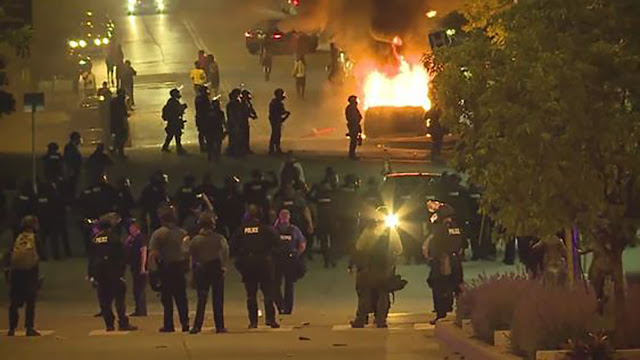
Night after night, rioters have vandalized, looted, and burned businesses and cars. It happened here in Kansas City, and in many other cities, too. One shocking casualty that hit the science fiction community extra-hard was the loss of the legendary Uncle Hugo's Science Fiction Bookstore in Minneapolis.

It's as if the transition from day to night turned people mean. In part, it seemed to become a self-fulfilling cycle. Authorities imposed curfews, in an effort to prevent violence. Police attempted to disperse crowds, in many cases using tear gas or pepper spray. Angry protesters fought back, and all hell broke loose.

After dark, the protests turned uglier. A Kansas City PD vehicle burns on Saturday night.
After dark, the protests turned uglier. A Kansas City PD vehicle burns on Saturday night, May 30, 2020.
(Many thanks to Fox 4 News for this photo).


A better kind of line-crossing


But I'd like to close this post on a brighter note. For all the anger on display, for all the ugliness after nightfall, and for all the brutality being protested, there were moments of positive "line-crossing." Of police officers taking a knee, joining a march, and reaching across barricades. And there were more of them than I recall having seen in past rounds of protests.

They, too, were mostly appalled at the way George Floyd died. Police forces in most of our cities are engaged in a long, slow effort to reform relations with their communities of color. There are a lot of fences to mend. A lot of history to overcome. That's why people are in the streets--again. Too many times, police officers have crossed that line in the wrong ways.

At left two Kansas City PD officers hold up a sign that reads, "End police brutality!" At right KCPD Chief Rick Smith and Kansas City Mayor Quinton Lucas kneel for a moment of silence for George Floyd, while holding up an "I can't breathe" T-shirt
Possible signs of change in Kansas City? At left two Kansas City PD officers hold up a sign that reads, "End police brutality!" At right KCPD Chief Rick Smith and Kansas City Mayor Quinton Lucas kneel for a moment of silence for George Floyd, while holding up an "I can't breathe" T-shirt. (Photos courtesy of Forbes, via Twitter and Katie Moore/Kansas City Star).


That needs to change. Our communities are calling for it. Police departments surely know it can't continue this way, and some places appear to be doing better

Let's nurture that change. Let's find ways to encourage and reinforce it. It's time for crossing the line of division, and reaching out toward healing.

IMAGE CREDITS

Many thanks to KCUR Kansas City and photographer Carlos Moreno, for the photo from Nareen Stokes's speech. Police stress poster image courtesy of Police Posters on Amazon. Many thanks to Fox 4 News for the photo from Saturday night. Photos of connections between police and community are courtesy of Forbes, via Twitter and Katie Moore/Kansas City Star. I appreciate all of you!


Monday, February 3, 2020

Nothing is simple

Nothing is simple, although it may look that way from the outside.

I found an article the other day in one of my online research resources, Police Magazine. It reported on a disturbance in New York City's Grand Central subway station. 

A group called Decolonize this Place organized it as part of a daylong series of demonstrations. This is the third time this group has staged demonstrations since earlier in 2019.

A still from a video from New York Post, via Police Magazine, showing the protest in the terminal. (Police Magazine/New York Post)

They didn't manage to close it down, as they'd hoped.

What they did manage to do was get national TV and other news coverage, and slow things down in Midtown. Reports on the size of the crowd and number of arrests varied. They left banners and sprayed graffiti, and tweeted about it. And they made an effort to look both intimidating and impossible to identify. Seems pretty obvious this group is up to no good, right?

Well, nothing is simple.

What's the goal of the disruption?

Photo from 1010 WINS Radio, via Twitter. (Note the
linked Twitter video contains profanity).
Let's unpack this. First of all, "end all policing" is connected to "destruction of public order." 

The goal is "to bring public safety back to NYC."

While the article in Police Magazine did list their goals as "no cops in the MTA, free transit [and] no harassment, " they focused more on the disruption and vandalism

That's not surprising. Their aim, as stated by MTA Chief Safety Officer Pat Warren (quoted in the article), is to protect "transit services that get New Yorkers to their jobs, schools, doctors and other places they need to go." Simple enough.

But nothing is simple.

How can the protests promote the need for public safety?


I'd just read another article about a UK study that demonstrated a 14-21% reduction in crime when the police patrolled subway stations every 15 minutes. These platforms previously had not had a police presence--exactly what the New York demonstrators are demanding.

The article even went so far as to make a direct comparison: "London’s Underground, akin to NYC’s subway system, was the first underground railway in the world, and now services more than 1.3 billion passengers per year."

The police show up and crime goes down. That's pretty simple, isn't it? But nothing is simple.

A study showed police patrols every 15 minutes in the London Underground deterred crime. Yet Decolonize this Place is demanding that police stop patrolling the New York City subways. Does this make sense? (Photo courtesy of Forensic).

 
Who's protecting whom, and from what?


The London Underground recently has seen delays from demonstrations, too, but those were staged by climate activists seeking attention. One of the biggest worries there seems to be terrorist attacks (and with good reason).

But hardly any of the London Underground's users seem to think the police themselves are a danger to public safety. No so, for Decolonize this Place. They demonstrated to remove them from the subways entirely

The New York City subway system's police officers, interacting with an assortment of low-income persons of color have been captured in distressing videos that went viral. This apparently happens frequently in the subways. 
The MTA recently (and controversially) hired 500 new officers to patrol the subways. They are there to address "quality of life" issues, such as illegal food vendors and the growing number of homeless people living in the subway system. 

Meanwhile, the NYPD has been cracking down on low-level crimes, and that's no surprise, since that kind of crime is up. But that often means focusing on persons of color, whether it's because of simple economics or racial bias. But addressing those issues, no matter how tactfully, is no simple matter.

Respect is not as simple a matter as it may seem. 


1981 Brixton Riots in the UK: first large-scale clash
between low-income black youths and white British
police in the 20th Century. (Photo from The
Royal Gazette
)
As far as I can tell, one clear problem with NYPD and MTA officers' approach is that it never seems to be respectful. Defensive, definitely--and in the current environment, caution is warranted.

But whatever their intentions, the effect when they surround a tiny, elderly churro vender with four or five much taller armed police officers and handcuff her is pretty darned intimidating.

This is not a new thing, this antagonism between police forces and the working poor. And it's not isolated to New York City. Fines that unfairly burdened lower-income residents of Ferguson MO fueled some of the fury in the wake of Michael Brown's killing. And all too often cities' attempts to "deal with the homeless problem" turn into efforts to chase the homeless out of town--or at least out of sight.

Officials used heavy equipment to clear out a homeless camp near Moncton, New Brunswick last May (photo by Shane Magee/CBC)

Even efforts designed to be helpful don't always succeed. Many places create task forces that include social workers to coordinate with the police, but their success is mixed. "Neighborhood policing" doesn't always have the desired result.

It's not just the working poor who feel disrespected. Police officers also have every reason to feel they are not respected. Indeed, too often they are violently targeted. "Bad actors" among sworn-officer ranks get sensational headlines, and besmirch the ones who honestly struggle each day to serve their communities.

Nothing is simple. Especially not efforts to negotiate the delicate balance of respect, accountability, and public order that characterizes interactions between the police and the working poor.

But it's quite simply true that everyone's safety and security depends on finding a way.

IMAGE CREDITS: 
Many thanks to Police Magazine (and New York Post) for the coverage of the protest, and to 1010 WINS Radio and Twitter for the tweet from Decolonize this Place. I'd also like to thank Forensic for the photo from the London Underground, and ABC-7 News for the screencap of homeless people in subways. Additionally,  much gratitude to The Royal Gazette for the historic photo from the Brixton Riots, as well as The Canadian Broadcasting Company (CBC) and their photographer/reporter Shane Magee for the photo from the Moncton NB homeless camp.