Showing posts with label What's Bred in the Bone. Show all posts

Wednesday, June 24, 2020

Rethinking policing for Rana Station

Rethinking policing has always been an important part of my world-building  for the futuristic world of my science fiction novels. Recent protests and calls to abolish or defund the police have given me fresh material to work with. 

But they haven't changed my plans for the series.

Jan S. Gephardt’s current “XK9” books are “The Other Side of Fear,” and “What’s Bred in the Bone.”
At the time this post went live, these were the "XK9 books" available. Cover art for The Other Side of Fear is © 2020 by Lucy A. Synk; Cover art for What's Bred in the Bone is © 2019 by Jody A. Lee.

Balancing reality and fiction


One of the joys of speculative fiction is that you get to make up your own world. That makes it possible to explore all sorts of thought experiments. How would this or that work out, if this or that other thing happened? The challenge that comes with the joy is making your world believable.

I wanted to combine my love of science fiction, dogs, and mystery stories into a science fiction series. 

But I couldn't assert spontaneously sapient, talking dogs (sure, that's believable . . . or is it?). No, they'd need to be engineered and equipped. Most people probably wouldn't do that for a pet. Contemporary smart dogs are already sometimes too smart for their own good. Plus it would be expensive, and take a long time. 

My fictional dogs needed a job that required the development. I already knew I wanted to write a mystery in this futuristic setting, so K9s--police dogs--were a natural choice. 

A German Shepherd places its paws on a computer keyboard in a police station office. The meme reads, "Saw bad man, bit same. End of Report."
They aren’t using computers yet, but dogs are smarter than we think. (GSCSafety/Donna Clayton/Pinterest)

I set my story on a space-based megastructure built on designs actual rocket scientists thought might work. My canine-cognition, robotics, and other research led me to other extrapolations. I hoped I'd figured it out so my readers could suspend their disbelief, and enjoy the story.

Reality and fiction in policing for Rana Station


But how to portray the police? I knew from the start that TV and movies were no guide. They tend to show cops as good-guy protagonists. They're frequently wildly erroneous. They often glorify, erase, or excuse terrible misconduct for the sake of drama. 

My original goal was to portray a style of policing that a real police officer could read and think, "yes, this is right. This is how it really works." 

Never having been a police officer or worked in that world, I had a lot of learning to do. But the more I've learned about the way it really works, the less I think it fits with the rest of how Rana Station is conceived. 

Several signs promote a growing push to defund and demilitarize the police.
The more I learned about how policing really works today in black and brown communities, the more I found myself in sympathy with concerns reflected in recent protests (Uncredited/The Hill)

The society on Rana Station is yet another thought experiment. This one is steeped in my roots as a teacher in urban schools. I built it on understandings from working on my Master's degree in Multicultural Education. As one of my characters says in a later chapter of What's Bred in the Bone, Rana's "governmental aim is to support the realization of each and every inhabitant-being's full potential."

The rest of the surrounding universe looks more like systems we're unfortunately familiar with. In some ways Ranans themselves don't live up to their ideals. In others, they do better. Part of the fun is speculating about what might happen when social systems, values, and priorities collide.

Rethinking crime 


One thing about humans: crimes happen. People screw up. They fight. Greed gets the best of them. Con artists run their scams. Passions rise, and sometimes people die. There are plenty of cases to solve, even on Rana Station. 

But a society built on respect for everyone, and dedicated to supporting their achieving full potential, isn't going to criminalize many of the things our society uses the police to address.

Members of the Pinellas Sheriff’s Department Forensics Team and St. Petersburg Police gather evidence at a murder scene in St. Petersburg, FL in 2017
When murders occur, they must be investigated. Members of the Pinellas Sheriff’s Department Forensics Team and St. Petersburg Police gather evidence at a murder scene in St. Petersburg, FL in 2017. (Uncredited/Tampa Bay Times)

Addiction isn't illegal on Rana Station. People can have small quantities of controlled substances. But authorities regulate potentially dangerous substances and try to stifle smuggling. Sapient-trafficking is illegal pretty much everywhere (but which beings are sapient?).

Digital thievery plagues everyone. Rana's "second-story men" (and women) sometimes intrude on residence towers. As in Chapter One of What's Bred in the Bone, people sometimes get mugged.

Assaults, rapes, and murders do still occur (although there are lots more conflict mediation efforts on Rana Station than in the USA right now).

And the XK9s, along with their human allies, are on the case.

Rethinking policing in more ways than one


But a social system designed to support every inhabitant-being reaching their full potential would not look like our reality. That means not only is the agriculture different. The schools are different. Ranan mental and physical health-care infrastructure is different (to name just a few).

And Ranan policing is different, too.

Today's "defund" advocates demand some changes that already were planned features on Rana Station. Even before our collective consciousness raising on police use of force. For instance, police won't be the first responders called for most mental health crises. Mental health professionals called "Listeners" will. Many current "de-criminalize" issues are handled outside of the justice system on Rana.

Police prepare to clear a camp set up by people experiencing homelessness in San Francisco, in 2017.
The criminalization of poverty reaches an extreme when it comes to people experiencing homelessness. Police prepare to clear a “homeless” camp in San Francisco, in 2017. (Judith Calson/San Francisco Public Press)

RReaders of What's Bred in the Bone may recall that the Orangeboro Police Department has a STAT Team (for "Special Tools and Techniques"). I originally called them a "SWAT" Team, but "Special Weapons and Tactics" recalls the old-fashioned militarized unit of contemporary practice. That's not what I intend to portray.

In very special circumstances some SWAT-like tactics may be needed. Think sharpshooters, or psychologist-trained negotiators. But Ranan STAT teams also embrace what we think of as search-and-rescue,  bomb squads and communications and surveillance specialists. They're known for saving lives, not kicking doors.


Rethinking police mental and physical health


One major area where my police research appalled me is the real world of police officer/first-responder stress. Rather than write in generalities, I'll share a summary of an all-too-typical case study. This one's from the March 2016 AA Grapevine, but unfortunately none of it seemed unusual, or out of step with other cases I've studied. 


Erika J.'s story

The writer was a young woman who'd wanted to be a police officer since she was in high school. Right at the start of her first rookie year she had a "suicide by cop" call. Although it was devastating, she felt compelled to "lie my butt off" to the department psychologist so she wouldn't lose her job. 

There are so many wrong things, just in that one element of her story.

From the beginning, this young employee understood if she was honest she'd be fired (like most people, she needed her job). She didn't feel supported, and that pattern continued. Later promoted to detective, she was "the only police officer in town assigned to juvenile cases." Not surprisingly, the caseload overwhelmed her. She asked for a reassignment after six years, unsure how many more autopsies of abused babies she could handle. Her request was denied.

So she "boarded out" and qualified for a promotion. Later, as a now-sergeant with a 3-month-old breastfeeding infant, they denied a reassignment that would make it easier to care for her baby. "I was told to quit whining and do my job." There's more. But if you're like me you've seen enough already. It's really not surprising this woman developed a problem with alcoholism. The way she was treated--by her brothers (and sisters?) in blue--ought to be criminal.

Mitchell, SD Police Officer Mici Bolgrean does paperwork.
Stress and feelings of isolation can build up for cops if they’re not given adequate support. Mitchell, SD Police Officer Mici Bolgrean does paperwork. Only 5% of South Dakota officers are female. (Sean Ryan/Republic)

So many wrong things


Instead, it's not uncommon. She probably got more grief because she was a woman (way to diversify, people!!). But male officers don't get much less pressure. That old-school police culture is toxic, no matter who's on the receiving end. As other pressures in society build virulence, police officer suicides have hit an upward trend.

Cops also work long hours with few breaks and little access to healthy food. That's why you see so many fat officers after they've been on the job for a while. They're usually not so much lazy as stressed-out and overextended. You won't be surprised that police officers are at 30-70% more risk of sudden cardiac arrest than others, when thrown into stressful situations.

It's not an acceptable reason, but it's easy to see how some officers grow jaded, callous, or abusive. That kind of job environment is practically a formula for inappropriately-displaced aggression. Give that human powder-keg a racist system to work in, a history of oppression and a gun, and you have a police brutality offense just looking for some "uppity" brown-skinned person to trigger it. 

Rethinking policing in a better way


Ranan culture doesn't put up with any of these ways of doing things. They are stupid, counter-productive, and deeply destructive. Excuse me while I'm "unrealistic," and explore a better way.

We need to ask why our own contemporary society puts up with those stupid, destructive ways of doing things. Must we abolish the police and start over from scratch to get rid of rampant, racist old-school police culture? If so, it might be a better way of rethinking policing than many people believe.

IMAGE CREDITS:

The covers of my books are from my Jan S. Gephardt’s Artdog Adventures website. Many thanks to Greater St. Cloud Public Safety Foundation, via Donna Clayton’s Pinterest Board, for the K9-making-a-report meme. I’m grateful to The Hill, for the photo of the “defund” protesters. Many thanks to the Tampa Bay Times for the photo of the murder scene investigation. I am grateful to Judith Calson of the San Francisco Public Press, for the photo of the police outside the "homeless camp." and thanks also to the Mitchell (SD) Republic and photographer Sean Ryan for the photo of Mitchell, SD Police Officer Mici Bolgrean at work. 
 

Wednesday, May 20, 2020

Growing Rana Station's agriculture

What's Bred in the Bone, Cover art © 2019 by
  Jody A. Lee
Rana Station's agriculture is a big part of my vision for the primary backdrop of my characters' lives. If you've read my first novel, What's Bred in the Bone, you've possibly gotten an inkling that very little arable soil inside the tori of my characters' habitat space station home lies fallow. Even small spaces are nearly all devoted to growing food.

I've blogged in the past about how humans will feed themselves and provide enough protein to live permanently in space. I've long been an interested follower of efforts to grow food crops on the International Space Station, as well as intensive gardening efforts here on earth.

Gardening sisters


Last week, my sister G. S. Norwood wrote on The Weird Blog about the joy, beauty, and health benefits of her gardening projects. Having grown up under the same influences, I've long been a gardener, too.

But while G. specializes in flowers, I've always been more of a fruits and veggies woman, myself. Having grown up in the '60s and '70s, I was always half-convinced I'd better hone my skills at organic gardening, in case I survived the coming nuclear armageddon, and needed to feed myself and others afterwards (unlike a prepper, I figured learning how to can the food I grow would feed me longer than squirreling away canned foods like Spam and beans).

I'd worked most of the summer of 1974 to buy that bicycle. I posed for it (with G.'s dog Finnian) in my garden. (photo probably taken by G. or our mother, to send to my then-boyfriend, now-husband, who was working in Colorado).

Eventually, worries about nuclear Armageddon receded as a real possibility in my maturing brain. But I still followed organic gardening methods. They appealed to my evolving environmentally-friendly consciousness.

More recently, in a concession to knee injuries, I've taken up container gardening. This has led to some interesting experiences--and inspired more ideas to use for Rana Station's agriculture.

New in 2019: I added a cedar planter to my patio container garden, seen here dominated by lettuce and marigolds. (photo by Jan S. Gephardt)


My thought-experiment world


These influences all combined in my world-building efforts on Rana Station. Years of watching how our world and its societies work, years of teaching, and years of gardening have given me some strong opinions. How better (or more sfnal!) to explore their possibilities and shortfalls than to test them out in a "thought-experiment" world?

In my concept, Rana Station's agriculture is not only necessary for their own consumption. It's also a key export that is vital to their economy. A problem every space-based habitat faces is how to feed its inhabitants. The more I looked at the possibilities, the clearer it became to me that the early NASA developers were not gardeners or farmers.

A year or so after my garden photo with Finnian and the bike, this was NASA's idea of farming on a space colony. Note the stark division between agricultural and residential areas. (detail of uncredited NASA photo found on Socks Studio.)

What if a gardener from farm country did take a whack at figuring out how to feed the 8.4 million humans and 2.4 million ozzirikkians I wanted on Rana? What would such an effort take?

Thinking outside of strict divisions


First, I eliminated the strange division between "agricultural" and "residential" areas that seemed endemic in many of the space colony concepts (Designed by men who never got food anywhere but a grocery store?).

"Salad wall" and raised bed give good examples of food grown intensively in a small amount of space. (Photo courtesy of QuickCrop).

There's no rule that swaths of land on a space station has to be devoted to grass (how unproductive!), or that residents can't live in a garden. Why not grow "veggie walls" in commercial buildings? Why not cultivate vine crops that hang from baskets or planter boxes on the residence towers' balconies?

Then I conceived my living area not as a broad, relatively flat plain, but more like the agricultural terraces of Yemen, Asia, and the Incas. I envisioned a convex/concave profile of the Ranan hillsides would maximize arable surface area.

Rice terraces of Longsheng (Longji) in China (Photo by Anna Frodesiak - Own work, Public Domain)

This also creates an endless, undulating river valley that accommodates natural patterns of water flow. Yes, they still have to dredge parts of it occasionally. But they'll have prepared for it.

Rana Station's agriculture and its economy


In my universe, Rana Stationers have made a name for themselves as an interstellar farmers market of the first order. Not being required to haul their fresh produce up from a planetary gravity well, they have a pricing and freshness advantage to offer the interstellar transports that stop over at the station to restock between transits through the local jump point.

Fresh produce from the Fresh and Local Farmers Market, near Arizona State University (photo courtesy of Facebook/Fresh and Local at ASU, via Phoenix New Times)

I think it's likely space environments will be dominated by utilitarian freeze-dried, frozen, and reconstituted foods in the form of microgravity-friendly ration bars, packets, or bulbs. In light of that, what sybaritic joy might fresh produce offer? I can imagine captains who plot their course through the Chayko System's jump point specifically to access the fruits of Rana Station's agriculture.

Taken in the Food Tasting lab in building 17: Bags of International Space Station food and utensils on tray, 2003. (Photo courtesy of NASA, via Wikimedia Commons).

Visions to come


I'm currently working with illustrators, and also on my own artwork, to come up with better ways to envision the station. I plan to share those efforts in future blog posts, and once I get my newsletter off the ground, they'll also show up there on occasion. I hope you'll join my explorations.

IMAGE CREDITS


What's Bred in the Bone cover art © 2019 by Jody A. Lee. The 1974 photo of me was probably taken by G. or our mother, to show off the bike to my then-boyfriend, now-husband. I took the photo of my most recent container-gardening addition. 

Many thanks to Socks Studio for the uncredited NASA photo of agriculture on a space colony; to QuickCrop, for the intensive planting photo; to Anna Frodesiak - Own work, Public Domain for the rice terraces photo; to the Phoenix New Times for the farmers market photo; and to NASA and Wikimedia Commonsfor the ISS food photo. I appreciate you all!

Wednesday, April 15, 2020

Creative amusements

Will you invent creative amusements, or run screaming berserk? I'm sure that's a real question for many people confined to quarters until further notice. Pandemic lockdown is a challenge, no matter who you are.


Essential workers don their masks each day like armor, then venture into a dangerous landscape where one thoughtless cough, like a ticking time bomb, could kill them this or next week.

Desperate times, they say, call for desperate measures. Or, sometimes, for creative amusements.

Above: Brooklyn's 7 Train and traffic below in pre-pandemic times. (uncredited photo from Medium)
Below: Almost the same scene, but with empty streets during the lockdown (Juan Arredondo for the New York Times).

A recipe for . . . ?

Creativity happens when divergent thinking runs up against a problem to solve. And oh my, do problems ever abound right now. I'm blessed to be one of the back-bench folks on this lockdown. I cheer from the cheap seats, but stay well out of the way while the real heroes do epic battle on the front lines. 

And I have plenty of creative work to do--I'm deep in final revisions on A Bone to Pick, the second book in the XK9 "Bones" Trilogy. And when I want to take a break there's always paper sculpture. But what about people confined to their homes or apartments, whose creative work is based somewhere else?

Our first three books are just the beginning. I'm working on A Bone to Pick now. (Weird Sisters Publishing).

I recently discovered two examples of just such people, and two very creative amusements. In each case they "made lemonade" from their less-than-ideal situations. I thought you might enjoy what they came up with.

A wedding photographer with no weddings to shoot


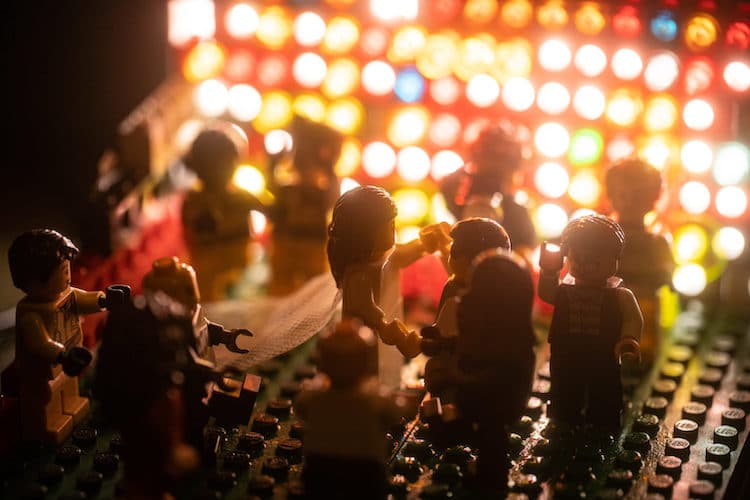
Chris Wallace of Carpe Diem Photography needed a wedding to photograph, but he had none. So he made up his own. Out of LEGOs. 

The resulting photo shoot not only gave a grown man an excellent excuse to play with plastic bricks and miniature figures, but when he posted the photos on his website he garnered memorable media and social media attention.

From his account of Florence and Fred's "magical day," and the assortment of wedding guests (who include, among many other notables, Chewbacca and Eleanor Twitty, the Library Ghost from Ghostbusters), it's clear Wallace had as much fun creating the event as we have viewing his photos.


See all these LEGO Wedding photos and many more by Chris Wallace, from My Modern Met and Carpe Diem Photography.

An artist, a museum curator, and two very cosmopolitan gerbils


It started as a Sunday project to mark a London-based couple's 14th day of quarantine. Before they were finished, artist Marianna Benetti and independent curator Filippo Lorenzin had turned it into an elaborate little gerbil-sized museum gallery.

They even created gerbil-centric masterpieces for the display (Oddly reminiscent of Vermeer's Girl with a Pearl Earring, Munch's The Scream, Klimt's The Kiss, and Da Vinci's Mona Lisa), and posted a highly futile "Please Don't Chew" sign.

Their two gerbils, Pandoro and Tiramisù, found plenty of interesting things to inspect, as documented in both still photography and a cute short video. 

Rude gallery patrons that they were, however, they not only chewed up a chair, but briefly gnawed on the "Don't Chew" sign itself. After all, gerbils just gotta chew.


These four "gerbils in the gallery" photos are from Marianna Benetti and Filippo Lorenzin, featuring their gerbils Pandoro and Tiramisù, via My Modern Met.

What creative amusements have you invented?


We should have lots more time to get cabin fever, go stir crazy . . . and maybe think up some creative amusements, too. How about you?

IMAGE CREDITS: 

Many thanks to Medium for the view of Brooklyn's 7 Train and traffic below, pre-pandemic; almost the same scene after the lockdown photo is from the New York Times/Juan Arredondo.

The three Weird Sisters Publishing book covers (with artist credits) are from Weird Sisters Publishing's Our Books page.

The four photos of "Florence and Fred's" LEGO wedding are by Chris Wallace of Carpe Diem Photography, via My Modern Met. Many thanks!

The four "gerbils in the gallery" photos are from Marianna Benetti and Filippo Lorenzin, featuring their gerbils Pandoro and Tiramisù, via My Modern Met. Deepest gratitude!

Wednesday, April 1, 2020

I've been published again! "The Other Side of Fear" is out!

This is a re-blog of a post about my book The Other Side of Fear, that went live yesterday on The Weird Blog. It's from my publisher, Weird Sisters Publishing.

We've teased you about The Other Side of Fear for the past couple of weeks--first with a front cover reveal, and then with a sample from Chapter One. 

Today Weird Sisters Publishing is proud to announce the arrival (sort of) of Jan S. Gephardt's new book, The Other Side of Fear!  It's now available in the Kindle Store. Other outlets may still "processing" it.

But we can give you more glimpses.

What's it about, anyway?


Here's the official book description for The Other Side of Fear:

Does she have what it takes?

Orangeboro police officer Pamela Gómez took her own dare. Now she’s headed planetside, to meet the challenge of her life.

XK9s are the newest, most powerful tool in law enforcement, but these super-dogs need human partners. The Orangeboro Police Department has purchased ten XK9s. Only an elite corps of officers will be chosen as their handlers.

Pam’s never had a dog, never left her home space station, and never thought of herself as an “elite” anything, but she took the courses, passed the tests, and made the cut. Now she’s an XK9 partner-candidate, bound for Planet Chayko, despite all her fears.

Does she have what it takes to handle an XK9? The answer to that will take her places she never dared to dream about.

Here's the complete cover for The Other Side of Fear

The Other Side of Fear cover art © 2020 by Lucy A. Synk.

You already know how we worked with artist Lucy A. Synk on this cover, developing the concept and sweating the small stuff. Right down to "What does an ashasata look like?" and "Who are all the people in the background?"

It's a book--but a book with a really tiny spine. The spine width on this wraparound cover art provided an exercise in miniaturization. The book only weighed in at 100 pages (after all, it's a novella, not a full novel). For those who haven't read What's Bred in the Bone, there's also a preview of Chapter One at the end.

But our Art Director hates to see a blank spine on a book, even if it's a skinny one. Wait till you see her tackle Deep Ellum Pawn. That's next up. If all goes well, Deep Ellum Pawn will be available in paperback and wide release by this time next week!

The Other Side of Fear Is now available!

The Kindle Store now has this title available. Keep checking your Barnes & Noble account, or hop onto Jan's Amazon Author Page. You should find it there soon!


IMAGE CREDIT: Many thanks to artist Lucy A. Synk for the cover artwork, which is © 2020 by Lucy A. Synk, all rights reserved.

Wednesday, November 20, 2019

Could it be love?

What's Bred in the Bone:
now available.
Does your dog love you? Or are you just projecting? Scientists try very hard to avoid anthropomorphizing their animal study subjects. Emotions are difficult to measure. But now we're finally getting closer to answering the question, "could it be love?"

This is the third and final (for now) post in a series about dog cognition. In case you missed them, click: "Dogs: verbal virtuosos?" and "How much does your dog understand?" I've also previously written about working dogs on this blog--a post that touched on dog cognition, but didn't go into as much depth.

This series started when I wrote a guest post on dog cognition for Booker T's Farm,  a blog devoted to books and dogs (a great combo!) Their format, however, didn't include the hyperlinks to sources that I'd suggested. (Note: Booker T's Farm also later posted a very nice review of What's Bred in the Bone).

Because science doesn't stand still, there's also some updated information to add. That (and the chance to share links to sources) is why I decided to expand on my August post with this series.

Anthropomorphism

Huckleberry Hound, Snoopy, and Scooby-Doo each created a humorous satire on certain human characteristics, but anthropomorphism gets in the way of scientists studying real dogs. (Images via Wikipedia)

When humans attribute human characteristics or emotions to non-human entities (weather conditions, animals, plants, gods or other things), they are anthropomorphizing. It's an impulse as old as human "behavioral modernity." In fact, one of our oldest artworks is anthropomorphic.

The so-called "Lion-Man of the Hohlenstein-Stadel," also called Löwenmensch figurine, is an ivory sculpture about a foot tall, that was found in Hohlenstein-Stadel cave in Germany. It's the oldest example of what everyone agrees is figurative art,  carbon-dated between 40,000 and 35,000 years old. You might recall dogs have probably been hanging out with humans somewhere in the neighborhood of 32,000 years.

So, yeah. We have an apparently-innate tendency to anthopomorphize all kinds of things (just for fun, run an image search with the keywords "faces on inanimate objects"). And while Huckleberry Hound, Snoopy, Scooby-Doo, and dozens of other anthropomorphic dogs might be fun ways to poke humor at certain types of human characteristics, but they do nothing to help scientists understand real dogs.

The right chemistry


A Golden Retriever who passes out hugs in New York City, a demonstrative rescued pit bull, and a Bernese Mountain Dog puppy who leans on his human and pulls him closer (Photos: varied sources/First for Women).

The human tendency to anthropomorphize may be hard to control for, but blood chemistry is entirely another matter, when we ask, "could it be love?"

Several studies have shown that oxytocin levels (the so-called “love hormone”) rise in both dogs and humans during interactions. When the human smiles, they look at each other, and when they snuggle, or when dogs are caressed, both release more oxytocin. Some researchers believe this mutual reaction is key to dog domestication.

In humans and other animals oxytocin is "correlated with the preferences of individuals to associate with members of their own group." Thus, it's not surprising that it's been found to be important in bonding between mates and mothers and their infants, as well as humans and companion animals.

Could it be love? Check the MRIs

At left, parallel brain structures in human and dog brains activated in response to stimuli (in this case words, but in other studies it's been smells) at Hungary’s Eötvös Loránd University. (image: Andics et al./Current Biology) Center: Border Collies and Golden Retrievers pose with the MRI in the Hungarian lab. (Photo: Borbala Ferenczy) At right, fMRI scans from Emory University show brain activity associated with decision-making. Similar studies using fMRI have demonstrated emotional reactions that parallel those of humans. (Photo: Berns et al./SSRN).
Oxytocin isn’t the only scientific proof that it could, indeed, be love. Studies of dogs in MRI scanners show the brain structure (caudate nucleus) associated with anticipation and positive feelings lights up in dogs when they smell the odor of a familiar person.

Other MRI-scan brain studies reconfirm the dogs' verbal recognition skills, and offer the beginnings of understanding how dogs make decisions.

And then there’s body language. How can you mistake the message of the facial expressions,  the wriggling body, the wagging tail? How can you mistake the hugs?

Could it be love? Watch this compilation of dogs greeting their returning soldiers home from deployment, then decide. What do you think?


Dog owners know: dogs “get” us, in a way few other animals do. After 30,000 years, even the scientists are beginning to agree.

IMAGE CREDITS: The cover art for What's Bred in the Bone is © 2019 by Jody A. Lee. Many thanks to Wikipedia for this images of Huckleberry Hound, Snoopy, and Scooby-Doo. Thanks and hugs to First For Women and their adorable photo feature, "12 Adorable Pics of Dogs Hugging their Humans for Valentine's Day," the source of the "Dog Hugs" composite. For the "Dog Brain Scans" composite, I wish to thank Wired Magazine, Attila Andics and Current Biology, photographer Borbala Ferenczy, and to Wired Magazine, Gregory Berns, and SSRN. Finally, many thanks to YouTube and FunnyPlox, for the video of dogs greeting their homecoming soldiers.