Wednesday, September 21, 2022

Not a Blog Post

The sisters in their childhood, and their books published through Weird Sisters Publishing.
The sisters (upper R), and the books they've so far published through Weird Sisters Publishing.

By Jan S. Gephardt and G. S. Norwood

Fair warning: This is not a blog post. G. and Jan are both dealing with health issues. This is beyond writing a blog post about taking a sick day (besides, Jan already did that). Neither one of us is feeling energetic enough to create a complete, well-rounded blog post this week. Since both of us have lifetimes of experience in deadline-driven careers, this is a hard thing to admit.

But sorry. This is not a blog post. We have been a lot more “on the ball” on past occasions, however. So instead of offering a new post, we thought we’d offer kind of a smorgasbord of some favorite past posts.


The first two stories in G. S. Norwood’s “Deep Ellum” series are “Deep Ellum Pawn” and “Deep Ellum Blues.”
Artwork ©2019 and 2020 by Chaz Kemp. (Courtesy of Weird Sisters Publishing).


Not A Blog Post, but Several

First, how about spending some quality time with pets, through some of our favorite past blog posts from G? If you’re familiar with the work of G.S. Norwood, you know her dry wit and her keen observer’s eye.

She has brought those qualities to her ongoing urban fiction series, the Deep Ellum Stories. These, not incidentally, include a range of wonderful animals, including Tidbit and Morsel, Ms. Eddy’s feline siblings who are considerably more than they seem. Then there’s Ace, the reformed Hell Hound, and even Fred, the back-yard mosasaur.

Read more about them in G’s novelettes Deep Ellum Pawn and its follow-up, Deep Ellum Blues. And stay tuned for G’s upcoming story, Death in Deep Ellum (set to be finished after she gets well). Meanwhile, even while this is technically not a blog post, we hope you enjoy this trio of G’s blog post “pet-classics.”


L-R: Fictional Tidbit meets real-life Scrap.
G's cats in art and life L-R: Ms. Eddy’s cat Tidbit, as envisioned ©2019 by Chaz Kemp, and Tidbit’s real-life inspiration, G’s cat Scrap, complete with her trademark curly tail. (The Weird Blog).


Cats in Space?

G. S. Norwood examines the roles of dogs and cats in Weird Sisters Publishing's fiction, and makes the case that there will be cats in space. We hope you’ll enjoy her post Cats in Space?

Because – can we talk? – if we humans actually do take to the stars, we won’t want to leave our companion animals behind. Science fiction is full of cats, dogs, and other critters who’ve voyaged with us in our fictional forays into the Final Frontier. If art mirrors life, there will be canine and feline spacefarers traveling with us.

Meanwhile, we think you’ll enjoy this post.


At left, Gift as a sickly kitten in a shelter. At right, G. with her sleek, healthy grown cat, Gift.
In just one year, the scrawny, snotty-nosed little calico G. found in the shelter underwent a remarkable transformation. But she still likes to cuddle. (Photos from G. S. Norwood’s private collection).


The Universe Gives Me a Cat

Urban fantasy writer G. S. Norwood, open to everyday magic in reality, says sometimes "the Universe gives me a cat," when she heeds intuition. What do you do, when the Universe has decided to give you a cat? Here’s G’s story.

Dog trainer Cesar Millan is fond of saying “You don’t always get the dog you want, but you get the dog you need.” We think that definitely goes for cats, too! Did G. get the cat she (didn’t know she) needed? Decide for yourself.


The members of the Texas Pack.
Clockwise from the top: “Sheriff” Zoe, a rather “wolfy” Chess on the prowl, and Kata with all-black Tam in G’s back yard. (The Weird Blog).


The Texas Pack

The Norwood household not only includes cats. It has a full cast of canine characters, too. G.S. Norwood introduces readers to The Texas Pack, her four border collies who each have distinct personalities, and who have informed her fiction.

Do you recognize any of the personality types she profiles in her blog post? Perhaps you’ve known dogs or other companion animals with similar approaches to life. Whether they’re interacting with humans or with each other, their personalities shine through.


Covers for the three XK9 books in print as of this post.
Prequel novella The Other Side of Fear, with Books One and Two of the XK9 “Bones” Trilogy: What’s Bred in the Bone and A Bone to Pick. Cover art ©2020 by Lucy A. Synk, and ©2019 and 2020 respectively, by Jody A. Lee. (Courtesy of Weird Sisters Publishing).


A Blog Post Series for Dog Lovers

Science fiction writer Jan S. Gephardt has done a different take on blog posts about pets – specifically dogs – and their unexpected capabilities. Even if this is not a blog post, if you’re in the mood for one, why not give these a try? Her series on canine cognition outlined some of the research she did for her science fictional universe. As veteran sf readers know, the “science” in science fiction means that writers ground their stories in actual, real-world scientific ideas.

Jan’s stories feature a pack of uplifted police dogs called XK9s. They help uphold the rule of law on Rana Station, their adopted space station home. Written as adventure mystery stories, they also offer glimpses of the sometimes-humorous ways in which truly sapient dogs might interact with the human world.

Hundreds of people have enjoyed her XK9 “Bones” Trilogy, a series of books which has earned some excellent niche rankings. The first two are available now from a variety of booksellers worldwide, as either ebooks or paperbacks. The third book in the Trilogy is set for release in 2023. Some may prefer to take a “test drive” with her prequel novella, The Other Side of Fear. It’s also available widely for sale as an ebook or paperback. Or get it FREE as an ebook if you sign up for Jan’s feature-packed monthly newsletter!


An illustration showing “social gazing” patterns of dog and humans.
A Finnish study demonstrated similarities between domestic dogs’ and humans’ “social gazing” behavior. (Artdog Adventures Blog).


Dog Cognition: How Much Does Your Dog Understand?

How much does your dog understand? A lot, actually, and on a more sophisticated level than many people think. “The Artdog” begins a new series on the research that convinced her dogs could someday be uplifted to be sapient beings.

Dogs may even be likelier candidates for future uplift than primates or cetaceans, for several excellent reasons. And seriously! What pet-parent wouldn’t love to know what their companion is trying to communicate sometimes? If only they could tell us in words! Turns out, maybe someday they can.


Chocolate Labrador “Fernie” responds to written commands.
Can a dog read? “Reading Dog” Fernie (here with his human, Nik Gardner) inspires elementary students at Headmaster Gardner’s UK primary school to learn to read. (Artdog Adventures Blog).


Dogs: Verbal Virtuosos?

Dogs as verbal virtuosos? When it comes to canine cognition, researchers are finding that dogs are real verbal virtuosos who know word meanings and can combine meaningful phrases. Alert readers of Jan’s novels might also recognize where she got the names for a couple of XK9s, after reading this blog post!

Jan wasn’t just anthropomorphizing (well, some – but not entirely!) when she gave the XK9s the ability to read and compose verbal replies. Until they get prosthetic thumbs, the ability to physically write won’t be in their, um, grasp. But they wield words (sometimes in several languages) pretty doggone well. And here’s her justification for thinking they someday really could!


Three dogs hug their humans.
MRI studies of brain patterns suggest these dogs aren’t just going through the motions. (Artdog Adventures Blog).


Could it be Love?

Could it be love? We've long worried that we're anthropomorphizing when we say our dogs love us. But more and more studies reveal the answer to "could it be love?" is YES!

Unfortunately, the video at the end of the blog post Could it be Love seems to no longer be available, but we hope you have seen similar behaviors in dogs (sorry – Jan had no energy to spare looking up a new video, but if you have time to go down a YouTube rabbit hole, we bet you can have fun finding more!).

Do the XK9s love their human partners? Absolutely! Pack is Family for XK9s, and their humans – including a few “extended Pack members” – are included in that circle.

Not a Blog Post, but we Hope You’ve enjoyed it

We hope you have fun reading through this “not a blog post” full of blog posts. We’re hoping and planning for one of us to be back in the saddle with new content for next week.

IMAGE CREDITS

We’ve pulled our images this week from the Weird Sisters Website and from the blog posts featured in this “not a blog post” article. Follow the links to the blog posts for full information on our image sources.

Wednesday, September 14, 2022

The Legend of the Undeserving Poor

By Jan S. Gephardt

A cluster of recent news articles have, to me, pointed to an older-than-America problem. I mean the recent water-quality issues in Jackson, MS, and the end of the universal free public school lunch program. A local infrastructure issue and a nationwide nutrition program might seem to have little in common, but under the surface they do. Both resulted, ultimately, because government officials bought into the Legend of the Undeserving Poor.

Now, before you get your feathers all ruffled about my obvious Bleeding-Heart-Liberal stripes showing, please hear me out. Certainly, there are unmotivated, indolent, and unwise individuals out there in the general population. They exist in all economic strata of society, from frivolous trust-fund babies on down. Users, grifters, and cheaters exist, and they certainly do their best to let the efforts of others “carry” them.

But years of studies, analysis, and personal experience should tell you that the growing ranks of the “Working Poor” in this country aren’t all (or even mostly) a bunch of so-called “Welfare Queens.” So where does this persistent legend of the undeserving poor come from, and why does it persist?


"Never let the truth get in the way of a good story." - Mark Twain
Some folks take this advice a bit too literally in public policy matters. (Statustown).


Tradition, Worldview, and Convenience

The legend of the undeserving poor is nothing new. It has the powerful forces of tradition, worldview, and convenience working in its support. Some historians say it dates back to the economic and social changes as the Plague waned in Europe. Wealthy people resented the growth of burgeoning “underclass” populations, with their desire for a better place in life than was comfortable for their “betters.”

My first inkling of how old (and unfair) the tradition might be while viewing Dutch art from the Reformation era (1500s-1600s). I was scandalized to see a mocking engraving that purported to illustrate disabled war veterans and other classes of the “undeserving poor.” How, I wondered, could anyone disabled while fighting for his country be considered “undeserving”? Of course, when you consider how the United States has treated 911 responders, as well as soldiers exposed to Agent Orange and burn pits, that outrage seems naïve at best. But then, it all makes me angry.

The legend of the undeserving poor has a long and ugly history. It offends anyone who values equity and social justice, and yet it persists. Why?


“Even climate action at home looks suspiciously like socialism to them; all the calls for high-density affordable housing and brand-new public transit are obviously just ways to give backdoor subsidies to the undeserving poor.” – Naomi Klein
Wouldn’t want to help the “undeserving,” of course! Not even if it helps to save the world. (Quotestats).


A Worldview Predicated on "Personal Responsibility"

Did you choose to be born to, or adopted by, the parents who reared you? Were you personally responsible for choosing the color of your skin? Not if you’re a natural-born human being, you didn’t. Yet these involuntary conditions are massive predictors of how successfully you’ll be able to live your life.

But it seems clear that some people in our society think the situation into which you were born should make no difference to your outcomes in life. Somehow, despite all the evidence to the contrary, they believe we all start from the same point and compete equally. If you didn’t struggle sufficiently to be an economic success – regardless of your opening situation – then that’s on you. Somehow, you are simply a lesser human being. And in that case, they appear to think that you deserve to just suffer and die, already.

It's a supremacist worldview. Weird, how often it’s held by people lucky enough to have been able to access opportunities and capitalize on them. You’ll often hear such folks describe themselves as “self-made” or having “pulled themselves up by their own bootstraps.” Never mind that the original definition for the latter phrase implied the completion of an impossible and unbelievable task. And if you somehow failed to do the impossible, well then, the legend of the undeserving poor is tolling the bell for you.


This cartoon shows what looks like a board game. One route, marked “Black” at the starting point, is long, winding, and includes lots of lost turns. Some of the sections say things like “Slavery, lose 100 turns,” or “Denial of Voting Rights, lose 10 turns.” The other route, marked “White” at the start is short, straight, and has sections that say “Free land from Indians, jump 2 spaces,” and (2 spaces later) “Free Labor from Slaves, take another turn.” A young White man near the end turns to his Black competitor and asks, “Are you just slow, or what?”
“The American Dream Game,” a 2014 David Horsey cartoon, is one of my favorite “pictures worth 1,000 words.” (LA Times, #142 of 200).


It is Inconvenient to Think Complex Thoughts

Thinking is hard. It actually uses energy and it can genuinely wear us out. That’s probably why some of us try to avoid doing it at all costs. Unfortunately, that attitude is kind of baked in to our culture. Americans (and, increasingly, supposedly-educated people everywhere) want clear-cut answers, they want them right now. Preferably in bullet-points that would fit on a bumper sticker. We’re already busy enough as it is. Our lives are already rife with complexity.

Unfortunately, our world faces a lot of complex problems, with multilayered causes. We need to solve them before they kill us. Climate change is one of those things that is complicated, famously inconvenient, and increasingly deadly. All the reasons why the legend of the undeserving poor is misleading and wrong are another.

But wait! If it's so bogus, why does it persist, you might ask. It persists because it is convenient for those who don’t want to engage their empathy for the “poors.” Even more so, for those who don’t want to spend any extra tax money (“my hard-earned money!” whether it truly came hard or was inherited) to help others live a better life.


"Power from unearned privilege can look like strength when it is in fact permission to escape or to dominate." - Peggy McIntosh
The legend of the undeserving poor persists because it serves unearned privilege. (AZ Quotes).


This falsehood, this enduring legend of the undeserving poor, perversely persists. It endures for the same reason a deeply misleading – but catchy – meme persists. Because it suits the purposes of undeserved privilege.

IMAGE CREDITS

Author/producer Jan S. Gephardt is grateful to all the image sources credited in the cutlines above. She isn’t quite Taking a Sick Day (after all, there is a blog post for today), but let’s just say she’s had peppier, healthier moments.


Wednesday, September 7, 2022

Bits and Pieces of Inspiration

 By Jan S. Gephardt

Sometimes a creative person “takes dictation from God” (or the muse, or whatever divine inspiration you want to evoke). That’s when the flow is strong and all the words, strokes, notes, or steps come out just right. Other times we are like gleaners coming into a field after the harvesters have been there. That’s when we find ourselves scrambling to find bits and pieces of inspiration.

For the past few days I’ve been in the “scrambling gleaners” group. All over the place mentally. With lots of disparate “input” coming my way. The bits and pieces of inspiration are like little sparkling jewels scattered through deep straw. They’re there. But what do they mean? How can I bring them together into some kind of a “whole” that works?


“Take your inspiration from wherever you find it, no matter how ridiculous.” — Roy H. Williams
Words to live by. Especially the “ridiculous” part. (Quotefancy).


Bits and Pieces

A great example of “bits and pieces of inspiration” lurks in my studio. They are paper sculpture projects I started years earlier but for various reasons couldn’t figure out how to finish. These are not “failed projects,” mind you. They just have to wait to be rediscovered at an opportune moment.

You see, when it comes to creative projects, I follow the adage “never throw anything away.” This drives my “neatnik” son crazy sometimes. But I’ve learned the hard way. About the time I think I’m never going to need something, a serendipitous idea tends to happen along. All at once, it’s the perfect “writing prompt” for the next scene. Or it’s a handy piece of already-drawn, colored, sculpted, and assembled artwork to match with this other thing that didn’t work with the original concept.

I do this often in my writing. But it’s easier to illustrate the idea with my paper sculpture.


The first dragon of the pair: top, the original 2014 drawing on a circle. L-R below: The first of several compositions to “star” this dragon was “Blue Pounce,” 2016. Another variation is “Aka-Bekko Dragon,” 2017, featuring iridescent paint and a scale pattern based on koi fish.
From its start as a drawing in 2014 (top), this little dragon “starred” in several art pieces. At left, Blue Pounce, 2016. At right, Aka-Bekko Dragon, 2017, inspired by the colors of a kind of koi fish. All images are ©2014-2017 by Jan S. Gephardt.


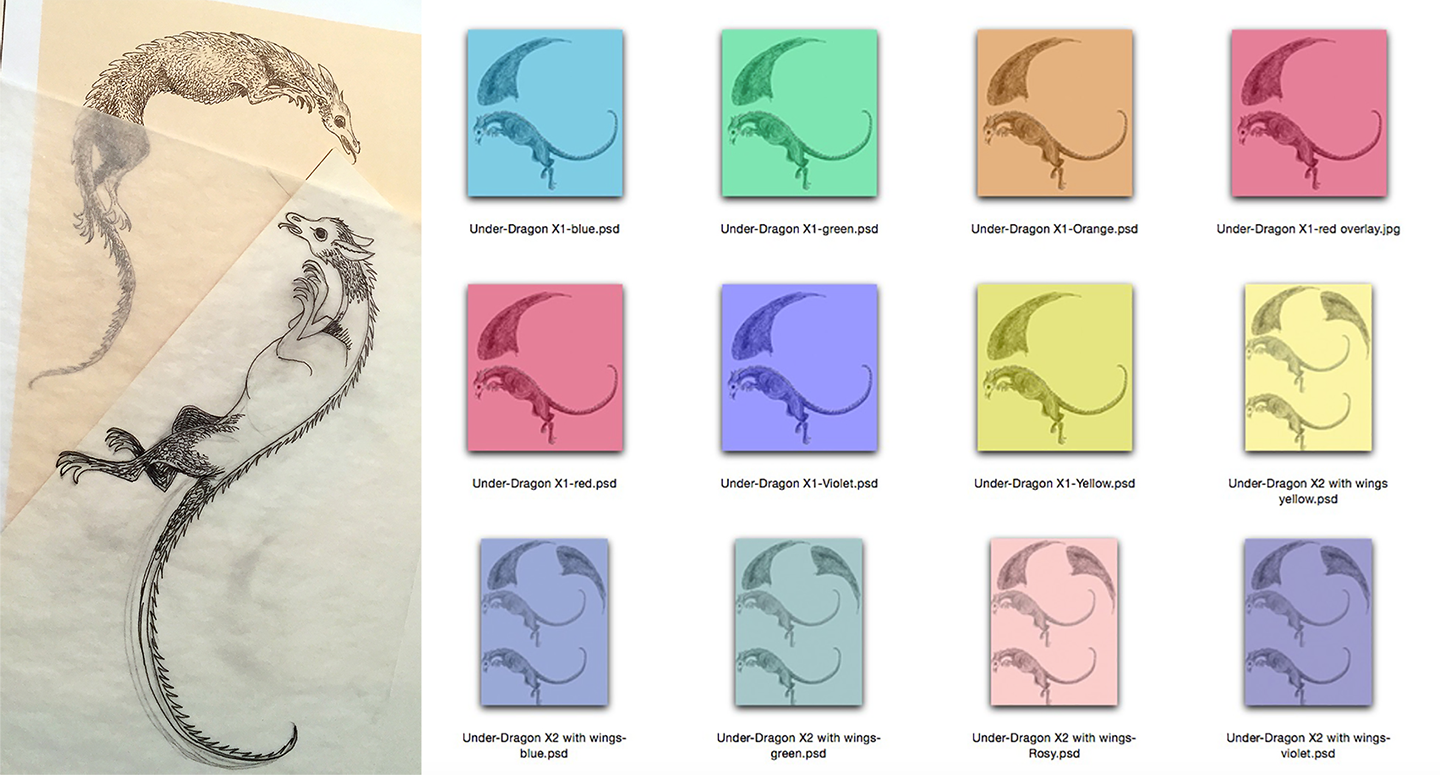
The second, “under-dragon” made its appearance in 2016. Pencil and ink on a tracing paper overlay ensured the two dragons intertwined as I wanted. Then I tested a variety of colors for the next layer.
The “under-dragon” didn’t go through quite as many variations, but after creating it as a pencil and ink drawing on an acid-free tracing paper overlay I tested it in several colors. Artwork is ©2016 by Jan S. Gephardt.


A Tale of Two Dragons

For a long time I’d had a concept of trying to create a circular composition with dragons in midair. I tried several sketches and they just didn’t please me. Nothing looked quite right to me. Finally in 2014 I got a “leaping dragon” on a circular trajectory that I liked. But when I tried to do a “reflected” version of that sketch for the “other half” of the draconian air-circle, it didn’t work. They were awkward with each other. Their tails didn’t fit. It was just bad.

I needed a different dragon. Tracing paper overlays and more frustration followed. I did “dragon variations” on the first design for other purposes. I sculpted it in larger and smaller sizes and made it different colors. Created Koi-patterned approaches. Painted it with iridescent paint before I cut and sculpted it. Most of those experiments sold within a few showings, so people must’ve found them interesting. But I wasn’t satisfied.


“Common Cliff Dragon – Male” at left is Jan’s best-selling multiple original. It depicts a cliff-dwelling dragon in “mating plumage.” At right, “Coming Through!” features an assertive unicorn stomping through a patch of daylilies.
Left-to-right: Common Cliff Dragon-Male and Coming Through! are shown in roughly proportional sizes. Both are multiple-original paper sculptures are ©2012-2022 by Jan S. Gephardt (these multiple-original iterations of the edition were sculpted and assembled in 2016).


Sometimes it Works, Sometimes it Doesn’t

Of course, I was working on other artwork during this time, as well as writing (and repeatedly rewriting) the manuscript that eventually became What’s Bred in the Bone. That was also the period when I designed Coming Through! and Common Cliff Dragon – Male. Both of those worked exactly as originally designed. Why couldn’t all of my pieces do that?

Because they don’t, that’s why. Sometime in 2016 I finally drew a second dragon that I thought really interacted well with the first. I’d at last managed a good “Yang” to the first dragons “Ying.” They didn’t look like they were fighting, though, so I scrapped that thought. By this time it was 2016, and there was plenty of other strife in the world. But they still needed a background. They couldn’t just do their love-dance in a void. They needed context.


These are some of the newest variations I’ve been exploring. Each piece is 2-3 layers deep and each level has a different color under the same drawing. Bottom levels are darkest (greens, blues, and orange tones), and the upper levels are white. The largest is a 3-inch square. Smaller pieces are 1-inch squares or 1X2-inch rectangles.
Here are the latest “enigmatic pieces” I’ve been working on. The largest is a 3-inch square. It’s a decade-long project: the original ink drawings were made in 2012. All images are ©2012-2022 by Jan S. Gephardt.


Picking Through the Bits and Pieces of Inspiration

So I started digging through the boxes and bins of “parts” in my studio. I’d been doing paper sculpture for quite a while by then. It took going through various phases before I kind of “found myself.” That process had left behind lots of bits and pieces. And when I say “lots” I do mean LOTS.


Here are the contents of two more bins from my studio. They are designs based on a variety of flower and branch forms.
People familiar with my work might recognize some of these “art parts,” from finished pieces in which I’ve used other versions of them. You might even be able to spot some in other photos in this blog post! All images are ©2012-2022 by Jan S. Gephardt.


These bits and pieces of “art parts” vary in style and polish of execution. Some just don’t go together. Some ideas occur to me as a single composition that’s all one drawing. An example of that? Common Cliff Dragon – Male. (The linked blog post goes into greater detail than I can here). It’s made of several pieces, but I did a “base drawing” then made overlays for the parts that needed to be executed separately.

That “needed to be executed separately” part is the thing that all too often gets me into trouble. When I try to bring several pieces that I made separately together into one composition I sometimes discover that I’ve gauged the scale slightly wrong. Or I’ve unintentionally varied the styles. Or maybe the pieces just “fight” with each other visually.


Here are yet more bins full of “art parts.” Most are flower or plant forms, some of which have showed up in other pieces of my artwork. Others include a lioness and an assortment of dragons. Some of those dragons have appeared in my finished art, but not all.
Again, some of you may recognize a number of these “art parts.” Can you spot some of them in other photos in this blog post! All images are ©2012-2022 by Jan S. Gephardt.


Chaos Waiting for Order

When the “art parts” don’t play nice with each other, they go into my holding boxes with the other quarrelsome bits and pieces. I’m not planning to stop making paper sculpture anytime soon, and I’m a patient woman. I mean, seriously. If I were an impatient artist I’d be making some other style of art!

So I put them in a box with some of their other troublesome cousins, and I keep cooking up new things. Or new combinations of old things. Take the pair of brand-new originals I debuted at Chicon 8 last week. Both are the result of “voyages of discovery” through the bits and pieces that hadn’t worked all that well in earlier combinations. Or they did work well, but that piece came together, was sold, and I’d thought it was completed. In this case, I found a background in my files that offered interesting potential. Here’s how the “variations” came out.


Here are two different artistic expressions on the same background “base design,” each piece “recycles” paper sculptural bits and pieces in a different way.
Variations on a background: each of these original works uses a common background drawing, but for quite different creative statements. L-R: Overcoming Complications and Gemflower Outburst, both © 2014-2022 by Jan S. Gephardt.


Love in the Storm

Remember the “Tale of Two Dragons,” above? When I left off in that story, I finally had a dragon pair that I liked, but not a background. What to do? Seeking inspiration, I went back through my bits and pieces. Eventually I found a “crashing wave” that looked promising. It hadn’t worked out as the background of an earlier piece, but I figured I might need it sometime. For something.

Well, that might work, I thought. So I made three copies of it and went to work. With a little cutting and fitting, it created a great background (in my opinion) for my “air-circle” dragons. I stepped back, lived with it for a while, and realized the waves formed a sort of a heart-shape. Woot! Serendipity won the day! That’s the origin-story for Love in the Storm, now a steadily-selling limited edition of multiple originals.


A green dragon and a red dragon conduct a wild mating dance in an atmosphere full of crashing waves.
The original composition of Love in the Storm finally came together in 2016. This paper sculpture is ©2014-2016 by Jan S. Gephardt.


Bits and Pieces of Inspiration

I look upon my boxes and bins of “art parts” as bits and pieces of inspiration. They continue to yield up treasures from time to time, although sometimes it takes years. I’ll give you another example, The Silver Lady Appears.

I started with a set of Alhambra-inspired columns in 2012 and tried a bunch of ideas and combinations that didn’t work. No matter what I did with it, it looked like a stage-set waiting for the actors. Probably close to a dozen ideas “auditioned” on that stage. Nope. Nada. Nothing.

Nothing, that is, until I found a way to paper-sculpt and assemble acid-free tracing paper. Then the Silver Lady materialized on the stage that had been waiting more than half a decade for her. And at that point the piece came right together.


The Silver Lady appeared at last in 2020, on the stage that had been in the process of being prepared for her since 2012.
It took from 2012 to 2020, but she finally showed up. The Silver Lady Appears, ©2012-2020 by Jan S. Gephardt.


After all that, you probably know what kind of advice I’m going to offer to anyone who’s involved in a creative pursuit in any field. However you do it, be it in a journal, digital files, or half-a-dozen bins of “art parts,” don’t throw away your “didn’t quite work” ideas. You never know when your next project might need some of those bits and pieces of inspiration!

IMAGE CREDITS

Most of the images in this post are straight out of the author’s digital files. All of the paper sculpture in this post is original artwork © 2012-2022 by Jan S. Gephardt. She also created all of the montages. Many thanks also to Quotefancy, for the Roy H. Williams quote at the top of the post.

Wednesday, August 31, 2022

Using My Time Well

By Jan S. Gephardt

Am I using my time well? It’s been my most persistent self-question this summer. I “wear a lot of hats” these days, which means I’m busier all the time. I’m quite possibly doing more things and being more productive than at any other point in my life.

But am I using my time well?

I’m the Chief Cat-Herder and Manager of Weirdness for Weird Sisters Publishing, which means I’m not only an author, I’m also involved in editorial oversight, I’m the Art Director, and I’m also the Director of Marketing. That’s a fair number of “hats.” As more projects come together, it’s on me to package and market them. As well as (in many cases) to create them in the first place.

Thus, if I’m using my time efficiently to accomplish a defined set of goals, I can hope I’m using my time well.


Weird Sisters Publishing: We have tales to tell. This picture shows covers for The XK9 Series, Deep Ellum Stories, and The Windhover Tetralogy.
We have a growing list of tales to tell. (See credits below).


Am I Busy with the Right Things?

I’m busy for sure. But am I busy with the right things? We never get it “all the way right,” I think. I remember sometime back in the 1980s or ‘90s sometime the business concept of “kaizen” or “continuous” improvement” was the buzzword of the moment in American business. I guess it had jumped the Pacific at some point not long after WWII, but somehow it took a while to be the Next Big Thing. We didn’t hear so much about it here on the Plains after the Asian Financial Crisis of 1997.

But the underlying concept is the basically-sound principle that you try something and learn from it. Did it work? Okay, do it again. Did it flop bigtime? Why was it such a failure? Where was the flaw in our thinking? Did it semi-flop, and there are things we can salvage? “Learning by doing” is what teachers and parents would call it, and it works in all kinds of concepts.

That does mean I have to continually interrogate my practices. Am I busy with the right things? Am I using my time well?


It is not enough to be busy . . . The question is: what are we busy about? – Henry David Thoreau
That really is the question, H.D.! (Rescue Time).

What you Need to Do Depends on Where you want to Go

The Big Question all self-employed people must answer each day is: how shall I structure my time? How do I figure out what’s the best thing to be “busy about”?

My son and I have been freelancers for years, so we’ve been refining the way we use time for a while. On the other hand, my Beloved just recently retired. People and events have been filling his time ever since, and I have a sense that he’s been feeling “drowned in stuff to do.”

Ty and I have tried to offer suggestions, and I think he’s beginning to get the hang of this self-time-management thing. But his struggles have given me a new chance to re-evaluate my own time-use habits and practices.


“Stop setting goals. Goals are pure fantasy unless you have a specific plan to achieve them.” — Stephen R. Covey
Confusing, after what I just wrote? Yes. But it’s the latter half of that quote we truly need to heed. (Quotefancy).

Establishing Goals

When I ask, “Am I using my time well?” what I’m really asking is whether the things I’m doing are helping me achieve my goals. As my Beloved has begun to learn, to achieve them, first you must envision them. After that, it’s easier to set priorities to reach them.

A good, achievable goal is both a vision and a commitment to act. “I want to be rich and famous” is just a pie-in-the-sky dream without a plan full of specific steps and a willingness to work one’s butt off. Also: fair warning from people who’ve been there. Being both rich and famous is a hazardous quest that may or may not be worth the prize at the end.

Am I using my time well? I believe that yes, you really can be “too rich and too thin.” You also can be too famous – certainly, it’s possible to be too famous to keep (or even legally expect to keep) your personal privacy. So, ditch the clichés. They’re not helpful. Each of us must decide for ourselves – specifically – what “success” looks like for us.


“Define success on your own terms, achieve it by your own rules, and build a life you’re proud to live.” — Anne Sweeney
Sounds simple, but it’s actually a call for soul-searching. And being specific. (Quotefancy).

Charting a Course Based on Goals isn’t Straightforward.

Setting priorities helps answer the question of “am I using my time well?” However, they’re not the whole answer. I still have to get from “here’s my vision of what I want to accomplish,” to “I’ll get there by doing these specific things.” And now I’d like to add one more, very important note. What you want, and how you think you’ll get there, will change.

My sister wrote a great blog post on how she found that out the “long and interesting way” in the course of her career. I won’t call it “the hard way.” That puts a needlessly negative spin on the journey of discovery that is everyone’s life. It can be hard. But it can also be joyous and rewarding (pro tip: how you look at it determines what it will be for you).

So, like everyone, I must define my goals. Use them to refine and hone my priorities. Then prepare to be flexible. G.’s vision of “what she wanted to be when she grew up” evolved over time, and so will anyone’s. The more we explore and learn, the more we’ll be able to judge whether we’re still on a good course for our personal lives.


“The key is not to prioritize what’s on your schedule, but to schedule your priorities.” — Stephen R. Covey
In other words, make sure you visualize where you want to go before you try to figure out what to do today! (Quotefancy).

It Still Gets Messy

Even then, it can get messy. It’s possible to pull up short at any moment in the journey and realize, “Oh, rats! I made a mistake! That’s not using my time well at all!” A process I envisioned as easy or productive turns into a logistical nightmare. Or maybe it takes, like, ten times longer than I expected – and unfortunately the learning curve wasn’t the only reason it took that long!

No one is immune – certainly not me! Anyone who thinks they have all the answers is fooling themselves. I try to remind myself: Kaizen, Jan, and hold fast to the reminder that no, “kaizen” is not the giant kaiju rising up out of the Pacific to destroy my schedule and spoil all my dreams.


This is a montage of two cartoons. In the first a knight is confronted by a fire-breathing dragon, and thinks, “DARN! There goes my To-Do list for today!” In the second cartoon, the first panel is marked “Your ‘Plans’.” In it, a person rides their bicycle up a straight, slight incline to a checkered flag. The second panel is marked, “The Universe’s Plans for you.” In it, our bicyclist confronts: 1. a much steeper incline. 2. a pit full of rocks. 3. a rope bridge over another pit. 4. a choice between a lake full of water with a boat and a steep climb to get out or a zipline. 5. More hills. 6. A steep canyon with a ladder to climb up the other side, but it’s raining on it. 7. Another steep incline – but there’s a sun shining from above. The checkered flag is not visible.
Time for a few more “learning takes”! (See credits below).

Instead of despair, what’s needed is what my son’s kindergarten teacher called a “learning take.” Oh, yes, and patience. Lots of patience. Maybe also some humility. We must be willing to admit we called it wrong and try again. Take a run at problems from another direction, and it might just unlock new insights.

And really, isn’t gaining a new understanding that unlocks a better way of doing something valuable in its own right? Yes, learning from a failed plan or a bad idea is frustrating. But gaining new insights and improving how I do things most definitely qualifies as using my time well!

IMAGE CREDITS

Once again, Quotefancy made it much easier to develop this post than it might otherwise have been. Many thanks to them for the two illustrated quotes from Stephen R. Covey, as well as the one from Anne Sweeney (see individual URLs in the cutlines). The Henry David Thoreau quote came courtesy of Rescue Time. Many thanks to both!

The Weird Sisters Publishing array of “Tales to tell” incorporates cover artwork © 2019-2022 by Jody A. Lee, Lucy A. Synk, and Chaz Kemp. That header image and the cartoon montage at the end of this post were designed and built by Jan S. Gephardt.

We owe particular thanks to two different sources for the cartoon montage. First, many thanks to cartoonist and “Psychotactics Blog” author, the talented Sean D’Souza. He created the “To-Do List”-busting dragon cartoon (read the blog post, while you’re at it!). Second, we really appreciate Doghouse Diaries, the original source of the much-reposted-but-seldom acknowledged cartoon about how one’s plans too often stack up against “The Universe’s Plans for You.” Thanks, Will, Ray, and Raf! We at Weird Sisters and Artdog Adventures appreciate you!