Wednesday, March 2, 2022

The First!

By Jan S. Gephardt

I’ve lived long enough to realize that, in this century, “the first” is always bittersweet.

Certainly, “The First Ever!” is exciting. There’s a sense of breakthrough, a sense of entering a new frontier, a new future in which the possibilities expanded. I remember The First American Woman in Space (Sally Ride). The First Woman Supreme Court Justice (Sandra Day O’Connor). The First Black President of the United States (Barack Obama).

I was one of the three million more people who cast our votes for The First Woman President of the United States. (Instead of the authoritarian loser con-man the Electoral College gave us). But these are all “firsts” that I, personally, in my lifetime remember. What went wrong with all the hundreds and thousands of years before that?
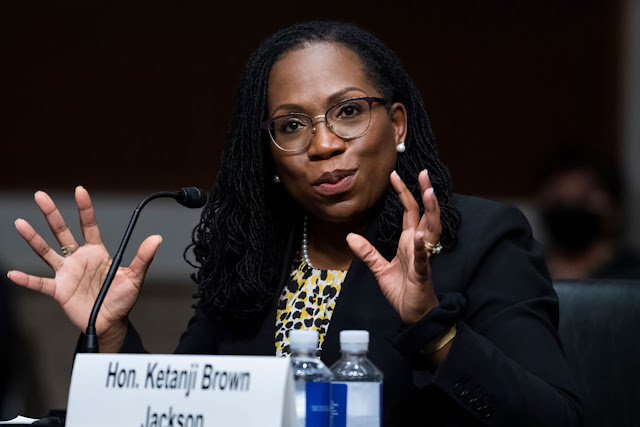

The Honorable Ketanji Brown Jackson testifies at an earlier confirmation hearing.
Ketanji Brown Jackson, nominee to be U.S. Circuit Judge for the District of Columbia Circuit, testifies during her Senate Judiciary Committee confirmation hearing in Dirksen Senate Office Building on April 28, 2021 in Washington, DC. The committee is holding the hearing on pending judicial nominations. (Photo by Tom Williams-Pool/Getty Images).


How Many Lost Opportunities?

In the flush of triumph over a brand-new “The First!” there are always a few inconvenient people. These folks fail to bask in the joy of the moment or celebrate an exhilarating milestone. Instead, they scowl and ask irritably, “What the hell took us so long?”

I have become one of those people.

I am delighted to greet President Biden's nomination of Ketanji Brown Jackson to the Supreme Court with applause. From what I’ve been able to learn about her, she’s perfect for the job. Especially when compared with certain recent previous nominees (currently serving), she’s vastly overqualified.

But nobody’s going to convince me she’s The-First-Ever-In-All-Of-History Black woman with the wisdom, discernment, and gravitas to be a Supreme Court Justice. How many others have there been in history, who – if given the chance, the education, and the opportunity – could have served as well or better than the ones we’ve had?


"So now the perception is, yes, women are here to stay. And when I'm sometimes asked when will there be enough [women on the Supreme Court]? And I say when there are nine, people are shocked. But there'd been nine men, and nobody's ever raised a question about that." - Ruth Bader Ginsburg
Nine female justices definitely would be an interesting reversal. (AZ Quotes).


232 Years. 120 Justices, 115 of Them Male and 117 White

A person would have to suffer from a titanic case of bigotry and misogyny to look at that header and not see prejudice. How, in all those 232 years, could mostly only white men be suitable – if not for a society weighted down and drowning in racial and gender bias?

I remember being exhilarated by Hillary Clinton’s so-called “cookie gaffe” in 1992, when she was on the campaign trail with Bill. "I suppose I could have stayed home and baked cookies and had teas, but what I decided to do was to fulfill my profession, which I entered before my husband was in public life," she said. Perhaps she did offend some stay-at-home moms (defensive, much?). As for me, I wanted to stand up and cheer.

Not because I have anything in particular against teas, cookies, or stay-at-home moms. In 1985 I became a stay-at-home mom, and I was one when she said that in ‘92. No, it was because back then there were a lot of people who made no bones about wanting women to “stay in their proper place” (read that: at home, with no public role, ever). Most of the folks who exerted that pressure were white men. Quite possibly, that’s because most of the people who got to have a say about things in those days (has it really changed that much?) were white men. But it’s certain that they preferred it that way.
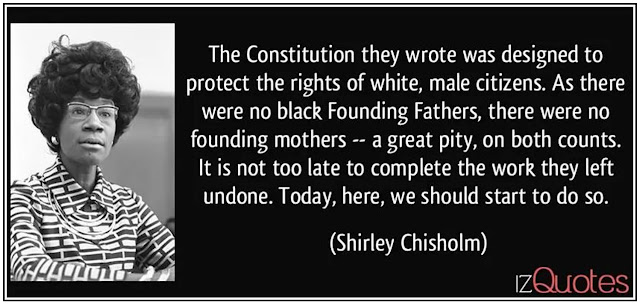

“The Constitution they wrote was designed to protect the rights of white, male citizens. As there were no Black Founding Fathers, there were no founding mothers – a great pity, on both counts. It is not too late to complete the work they left undone. Today, here, we should start to do so.” – Shirley Chisholm
The work she wanted to start “today” was creating the Equal Rights Amendment. It still hasn’t been ratified today. (IZ Quotes).


Lots of Oppression to Spread Around

During Women’s History Month, we often get a double-dose of “remember The First!” stories. They’re often couched as a courageous fight for equal rights, and they certainly were. If you doubt that, contemplate the life and struggles of Alice Paul, for just one example.

The stories of Women’s History Month, like the stories of just-ended Black History Month, are stories about struggles in the face of powerful oppression. This oppression has come from established societal norms and from laws. It has often been enforced with great brutality, against persons made helpless and defenseless by all the combined powers in the world around them.

But, especially in the case of women, the oppression often hasn’t been exerted by strangers or conquering foreigners. No, this pervasive oppression all too frequently has come from our own family members and our own intimate partners. The people with whom we’ve lived most closely and love dearly. They (and we, embedded in cultural norms) often haven’t even recognized it as oppression.

Perhaps our oppressors saw it as “protection.” Maybe they saw it as “sheltering.” They may even have seen it as “nurturing.” But “It’s for your own good” is the deepest cut of all, when you’re being held back, held down, and kept from achieving your full potential.


Some screen-captured results from Google searches for “the first woman . . .” and “the first Black . . .”
Here’s what “the Google test” turned up for these searches. (See credits below).


Try the Google Test

While I was preparing this post, I tried “the Google test.” That’s where I type in the beginning of a phrase and see what the algorithm fills in. It offers a glimpse of some commonly-searched-for topics, including things trending lately. Which is probably why, when I typed in “The first Latinx . . .” so many answers came back about the Oscars. I’ll admit I was kind of astonished to find that my search for “The first Black . . .” turned up zero references to female Supreme Court nominees, although we did get Thurgood Marshall in there.

My beloved United States has come up with a lot of forms of oppression in its history. I shouldn’t be shocked. But I always am a bit more saddened, when I remember yet another category-label variation of “human” that my fellow countrypersons have found it agreeable to oppress.
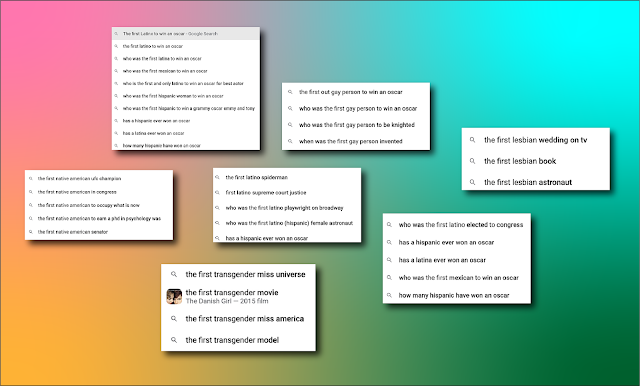

Some screen-captured results from Google searches for first Latinx, Native American, Asian-American, and LGBTQIA+ people.
More “Google tests” and more results. (See credits below).


The First of Any Distinguished Category

I hope that by now I’ve clarified what I mean when I say that, in this century, “the first” is always bittersweet. Whenever there’s a “The First!” of any distinguished category, that means there has been a whole world of hurt, degradation, and missed opportunities in the past. Oppression of some kind has deprived us of untold brilliant individuals until this first one now.

They could have improved our lives, expanded our minds, and brought their own unique power and possibility into the larger world. But oppression strangled their voices. It smothered their options, and murdered their visions. Oppression, like war, is a destroyer. But while war is flashier and louder, oppression is more pervasive. Like a miasma, it spreads everywhere and relentlessly kills the light.

When we live to see a “The First!” we do see a moment of hope, but it perhaps shines brighter because it shines out against a deep history of darkness, evil, and oppression. Every triumphant “The First!” is a marker that says, “oppression lingers here.” It’s bittersweet because it took so long and cost so much. And because we know that it’s not a “streak” yet. It might prove to be a solitary exception that the powers of oppression could turn into a token and use against further progress.

But we’ll take it, all the same. Because every “The First!” story is far, far better than the all-too-great multitude of “Never Yet in This World” laments.
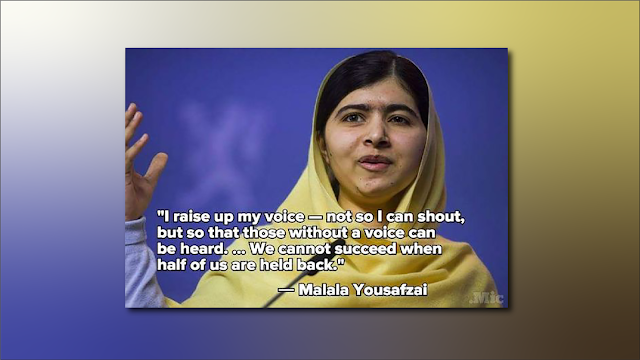

“I raise up my voice – not so I can shout, but so that those without a voice can be heard. . . . We cannot succeed when half of us are held back.” – Malala Yousafzai
Misogyny is very far from only being isolated to the United States. Here, at least educating girls isn’t controversial! (See credits below).


IMAGE CREDITS

Many thanks to Ohio Capital Journal, photographer Tom Williams-Pool and Getty Images, for the photo of the Honorable Ketanji Brown Jackson at a previous confirmation hearing. We’re grateful to AZ Quotes for the quote-image from Ruth Bader Ginsburg, and to IZ Quotes, for the quote from Shirley Chisholm.

We also must appreciate Google’s search engine for all the screen-captured search results. Jan S. Gephardt assembled and designed the montages. Finally, the quote from Malala Yousafzai comes courtesy of MIC Network, via Artdog Adventures. It was the “Artdog Quote of the Week” on March 5, 2018. Many thanks to all!

Wednesday, February 23, 2022

Is Texas Crazy?

By G. S. Norwood

I have chosen to live in the Lone Star State for more than thirty years. Since I wasn’t born and raised here, I have something of an outsider’s view when it comes to the cultural norms of White Texas society. It doesn’t take much observation to realize that more than a few things about my adopted state are . . . well, kinda screwy. It’s enough to make a rational gal like me ask, “Is Texas crazy?”

Weather

Every state in the union claims the old adage, If you don’t like the weather, wait a minute.” But Texas weather really does go to extremes. Just over a year ago, Texas was suffering through what we now unlovingly refer to as the Great Texas Deep Freeze. Temperatures got extremely low for a state this far south. The electric grid nearly collapsed from the demand for heat.

And then things got dangerous. In one of the most prosperous states in our technologically-advanced country, more than 4 million people lost power—some of them for days on end. Nearly 250 people froze to death as a result of the storm, and I’m not talking about street sleepers. When your house has no heat for more than 24 hours, anyone can become vulnerable. Read about my own experience in last year’s blog post, Surviving a Not-So-Natural Disaster.


A collage of “Texas Weather” memes, plus the forecast with icons G. described as “giant Ice meteors,” from G’s phone. Those that don’t depend on the photos for meaning say, “ Texas weather just be throwing out temperatures like Powerball numbers: 32, 73, 56, 9, 47.” “Betcha can’t go from -1 to 70 in one week. Texas says: ‘Hold my beer.’” And, “Texas has two seasons: summer & winter. Usually they alternate days within the same week.”
Is Texas crazy? When it comes to the weather, “Yes!” (See credits below).


The weather isn’t usually that severe, but it can still be a little wacky. Take this week, for example. On Monday, we’ll have cloudy skies, but the daytime high will hit somewhere close to 80°F. On Wednesday and Thursday we can, if we believe the forecast icons, expect giant ice meteors—or at least sleet—despite the fact that the daytime temps could reach the 40s. Is Texas crazy? When it comes to the weather, I have to say, “Yes!”

Where the East Peters Out

Culturally, Texas can also show signs of a split personality. To a lot of people, Texas means cowboys, or at least a cowboy lifestyle—boots, jeans, Stetson hats. “Yes ma’am,” and “all y’all.” But in today’s Texas, that cowboy thing is only a reality in the western part of the state. Legendary Fort Worth journalist Amon Carter declared Fort Worth is where the West begins,” and he had a point. Out on the open plains beyond Fort Worth, ranching is still big business, although many folks have traded in their horses for a good Ford F-150 pickup truck.


Left-to-right, rural Parker County west of Ft. Worth; Fort Worth’s skyline and the Trinity River; the Big Tex statue in Fair Park; the skyscrapers in Dallas; and rural Collin County, northeast of Dallas, all in northeast Texas.
Photos from both rural and urban parts of the DFW Metroplex: Ft. Worth and Dallas each have their own unique characteristics, but Big Tex greets everyone with a great big “Howdy!” (See credits below).


But if Fort Worth is where the West begins, that means Dallas is where the East peters out, and there’s some truth to that as well. Despite the popular television franchise, Dallas isn’t really about oil. Dallas is about oil money. Before that, it was about cotton money. Or cattle money. Any kind of money, really. Dallas built itself on banking and commerce, and it looked eastward for inspiration when the city fathers sought to position Dallas as a center of civilization, not a crude outpost on the far frontier. They built churches and founded symphonies. They established art museums and created retail stores that became legendary for their fashion and flair.

West of Fort Worth, folks might still greet you with a friendly “hahdie.” The only one in Dallas who still says “Howdy” is Big Tex.

So, is Texas about cowboys? Or is it about the sleek trappings of modern wealth? It’s both, really. As well as the hippie vibe and high tech of Austin, and the deeply rooted Hispanic culture of San Antonio. It’s about all of it, from haute cuisine to street tacos and barbecue joints. Texas is a big state, with room for multitudes.


A young teen in an orange, black and white outfit sports a matching mum her mother made; four young ladies pause at their Homecoming breakfast to pose; and a dating couple poses by a pool to show off their coordinated garter and mum designs.
Non-Texans can only gape in awe at the size, colors, and endless, creative variety that makes each Homecoming Mum and Garter an amazing production. (See credits below).


Homecoming Mums

Some Texas stuff, however, is just inexplicably weird. There’s the way everybody automatically claps four times in the middle of singing Deep in the Heart of Texas. Or high school football games, which are far more popular and important to most people than anything those professional guys in the blue and silver uniforms do.

Maybe it’s because high school football is such a big deal that high school homecoming celebrations have become such a big deal, too. And the biggest big deal of any high school homecoming celebration in Texas is the Homecoming Mum.


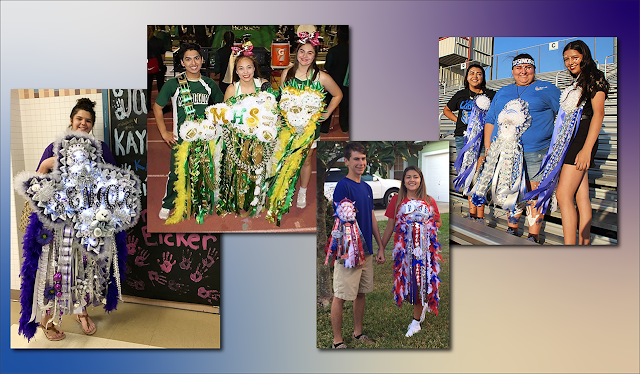
A black-and-white mum design the shape of Texas, held by its creator; a trio of “MHS” mums wearers in green, gold, and white; elaborate, red-white-and-blue coordinated garter and mum; and a trio of “Lobos” boosters sport blue, silver and white mums.
All over Texas, every year they’re in high school, teens of all genders create or buy and proudly display their Homecoming mums and garters. (See credits below).


Not content to drape young ladies in a simple corsage at homecoming, Texans build huge, elaborate floral . . . Things. With ribbons, and charms, lights and teddy bears and . . . Stuff. Sometimes the mums are bigger than the girls who wear/carry them. Sometimes the mums come as part of a suite of flowers, including armlet garters for the guys. Some Texas mothers have been known to start home-based businesses to feed the Homecoming Mum mania. Is Texas crazy? When it comes to Homecoming Mums, the answer is definitely, “Yes!”

So, Is Texas Crazy?

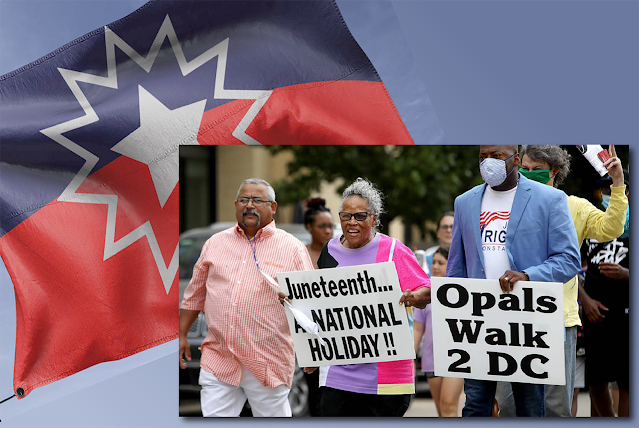
Any state that keeps re-electing politicians who ignore a failing foster care system, but obsess about where transgender people go to pee, has to have a large ration of crazy in the mix. At the same time, any state that can produce a fierce fighter for civil rights like Opal Lee has to offer up an equally large serving of vision and humanity. Thanks to Opal Lee, Juneteenth—an observance I had never heard of until I moved to Texas—is now a national holiday. Who can’t get behind a day that celebrates the end of human enslavement in our nation? Shouldn’t we all at least raise a beer to that?


At left, the Juneteenth flag. At right, Opal Lee leads a group down a street in Ft. Worth in 2020. She carries a sign that says, “Juneteenth … a National Holiday!!” The man next to her carries a sign that says, “Opal’s Walk 2 DC.”
The amazing Texan, Opal Lee, persisted until Juneteenth became a national holiday. (See credits below).


Texas is the second fastest-growing state in the country. Even in these pandemic years, when many people have chosen to hunker down wherever they are and stay in familiar surroundings, the Texas Relocation Report 2021 estimates that more than 500,000 people moved to Texas in 2019. That was the seventh year in a row to see the new Texas residents top 500,000. Folks come here to find better jobs, more affordable housing, warmer weather, or just a wide-open horizon that promises all kinds of possibilities.


Flow of People Moving to Texas from other cities in the United States: On a map background with an illustration of people moving, are these statistics from 2020: California, 62,767. Arizona, 15,294. Colorado, 8,768. Oklahoma, 21,401. Illinois, 22,552. Louisiana, 26,469. New York, 20,909. Virginia, 18,741. North Carolina, 15,803, and Florida, 35,188.
Texas is the second-fastest-growing state in the USA. Is Texas crazy? Or are people simply crazy about it? (illustration courtesy of Reform Austin).


Is Texas is crazy? Yes! It’s crazy big, and crazy diverse, and it can swing from horrifying to hilarious at a moment’s notice. It has crazy weather and crazy customs. And it’s jam-packed with wonderful, awful, loveable, deeply human people from all over the world, who bring all their baggage with them when they come. Is it any wonder so many people move here? For now, at least, I wouldn’t want to live anywhere else.

IMAGE CREDITS

We have a lot of people to thank for the photos and other images in this post. All of the montages were designed and assembled by Jan S. Gephardt. For the “Weather Memes” illustration, we are indebted to Austin.com for “one weekend in Austin;” to Digital Mom Blog for the “-1 to 70” and “Powerball Numbers” memes; to Wide Open Country for “two seasons alternate days,” and to a “Dallas” subreddit for the “Texas Weather Last Week/This Week” meme. G. did a screen-grab of whatever weather app she has on her phone for the “week’s weather forecast with ‘ice-meteor’ icons.” The Texas flag that underlies them came from the Belson company.

The ”Fort Worth and Dallas” montage includes photos of the Dallas and Ft. Worth urban centers, both courtesy of Ted Bauer and White Rock Locators. “Hello Little Home” contributed the photo of Big Tex, without whom it just wouldn’t be the State Fair. We’d like to thank “Land and Farm” for the photo of the rural land in Collin County, TX that backs the Dallas photo. Jan took the photo that backs the Ft. Worth photo in March, 2005, not far from where G. and Warren lived at that time.

Those Mind-Blowing Homecoming Mums!

Jan admits she went a little, um, yes, crazy with the Homecoming Mum pictures, but the extravagant creativity and variety made it hard to narrow them down. In the first montage, Misty Owen created the “M”-emblazoned, orange-black-and-white mum her daughter holds in the picture, and sent the photo to the Dallas Morning News. I’m indebted to The Colt News for the group of four young women with their mums at their school’s Homecoming breakfast; they didn’t name the young ladies or their school. Young men’s garters are only somewhat less elaborate than their female dates’ mums, as you can see from the poolside photo of Emily and David (no last names or locations given). Many thanks for it from "Texas Traditions" on Facebook.

In the second Homecoming Mums montage, the ambitious and resourceful young woman whose corsage almost seems to be wearing her is Brittany Eicker. Her “Texas” mum made the Wall Street Journal, although she also showed up on at least one other website, too. The photo of the grinning trio from “MHS” came courtesy of My San Antonio. And the Hays Free Press provided the red-white-and-blue mum and garter pair, as well as the trio of Lehman High School Lobos boosters, L-R, Faith Parra, Sarah Miranda, and Rosa Fabian. Many thanks to all!

More Texas Topics

The amazing Opal Lee and her Juneteenth project provide plenty of inspiration, including for the fifth montage. At left, the official Juneteenth Flag is full of symbolic meaning. The photo of this particular flag is courtesy of North Carolina State College of Education. The Ft. Worth Star-Telegram provided the Amanda McCoy photo of Opal Lee leading a group down Lancaster Avenue in Ft. Worth on June 19, 2020.

Finally, we thank Reform Austin for the illustration-map showing places large groups of new Texans have left behind, and how many did so in a recent year (probably 2019 or 2018). 

Thursday, February 17, 2022

Equal civil rights for all

The Future We Want – Part 3

By Jan S. Gephardt

Now here’s a radical thought: a country where equal civil rights for all is a reality. Do we have any such place in the world today? I can’t say for sure, but I do know one thing. The United States is currently no such place.

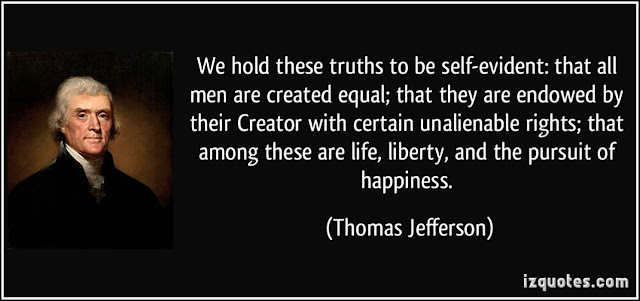
Yes, I know Thomas Jefferson’s words in the Declaration of Independence said it’s “self-evident” that “all men are created equal.” But even he and his fellow rich, white, male, slave-owning revolutionaries didn’t mean that literally.

I have been hearing a wide variety of exceptions and variations on this quote all my life, mostly to point out ways it’s not true or fudge the “rule,” rather than to seriously embrace the idea that it actually, like ever happens. Because, of course, we realize it doesn’t.


"We hold these truths to be self-evident, that all men are created equal, that they are endowed by their Creator with certain unalienable Rights, that among these are Life, Liberty and the pursuit of Happiness." - Thomas Jefferson
(Courtesy of Quote Thee).


Equal, with Rights?

The rest of the “all men are created equal” thought immediately links equality to rights: “that they [the “all men” who are equal] are endowed by their Creator with certain unalienable Rights.” But, to quote another popular phrase, “The devil is in the details.” Certainly, Thomas Jefferson didn’t think “all men are created equal” meant all of humanity. Considering how he treated Sally Hemings, he certainly didn’t mean either women or slaves.

Nor did the US Constitution and the Bill of Rights clearly establish just exactly what “unalienable Rights” the Creator (or, more practically, the government) might have endowed upon them. “Life, Liberty, and the pursuit of Happiness” is a bit too vague and sweeping to be helpful in a court of law. It certainly can’t, and never did, guarantee equal civil rights for all.

I spent four weeks in July 2020 discussing the First Amendment alone, and how difficult it is to nail down specifics. If you’d like to see those posts, they start with “Freedom of Religion: Is the First Amendment an Aspiration?” (July 2, 2020) and run through “The Importance of Freedom of the Press” (July 29, 2020). But the quest for equal civil rights for all goes beyond the First Amendment.


Elizabeth Cady Stanton: “We hold these truths to be self-evident: that all men and women are created equal.” Chief Joseph: “The earth is the mother of all people, and all people should have equal rights upon it.” Harvey Milk: “All men are created equal. No matter how hard they try, they can never erase those words. That is what America is about.”
(See credits below).


Equality and Equity

It would be easy and convenient if equality and equity were the same thing, achievable by simple weights and measures. But they’re not. Equality means everyone gets exactly the same treatment, or pay, or goods, or whatever. And in some cases that’s exactly the right approach.

Two people do the exact same job for a company? They should be paid equally – even if one is a woman or a member of a minority. That’s not to say that if one does extra work s/he shouldn’t be paid a bonus. But again, each should get an equal chance to earn that bonus. That’s simple fairness.

Sometimes it’s that easy, but most of the time It’s not. To echo Napoleon the Pig in George Orwell’s Animal Farm, it becomes a problem when “some animals are more equal than others.” When the goal is actual, genuine equal civil rights for all? Oh, that’s never been easy! In fact, lately it seems to be growing harder and harder to secure.


All animals are equal, but some animals are more equal than others." - George Orwell
(Courtesy of Magical Quote).


A Tale of Two Little Girls

Here’s another equality/equity hypothetical situation. Say there are two smart little girls. One lives in a nice suburb, goes to an expensive science camp in the summer, and has a grandma in another city who likes to take her to the theatre and kids’ museums whenever she visits. She is well-traveled, well-fed, in excellent health, and her education never lacks for enrichment.

The other kid grew up in a series of shabby, drafty apartments, in between stints of living in the family car. She’s always hungry. She lives in a dangerous part of town, where people sometimes find dead bodies on the street or in their yards. Her mom works two jobs and can’t stay home with her much, so her auntie keeps an eye on her, along with her three cousins, whom the auntie favors. They never go out because Auntie’s immigration status is “iffy.”

Do these two little girls, of equivalent intelligence, both have an equal chance to do well in school? Of course not. That’s where the question of equity comes in. The first little girl has all kinds of advantages the second one can’t access without extra help from the school and the community. Help she may or may not (probably won’t) get, depending on where she lives and what the State Legislature’s priorities are And, as we all know, these priorities are rarely in the best interest of smart little girls in poverty-stricken neighborhoods.


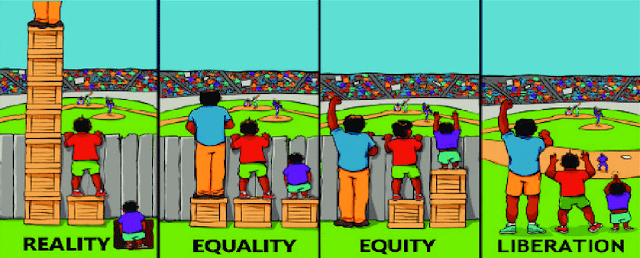
In the “reality” section, the differences in resources are extreme between three kids looking over a fence at a baseball game. One stands on a whole pile of boxes, one can see over, standing on one box, and the littlest one is standing in a hole. Can’t see over at all. In the “Equality” section each kid stands on a box. The tall kid can easily see over, the middle kid is unchanged, and the little one stands on his box but still can’t see over. In the “Equity” section, the tall kid didn’t need his box. He can still see over. The middle kid is unchanged. He can see over, too. The smallest one now stands on two boxes, and can see over the fence! In the ”Liberation” section, all can see, without the aid of boxes, because there is no fence.
(See credits below).


What’s the End Goal?

The reality in which we live is far different from any abstract ideal of equality. And even equality needs adjustments in how resources are distributed, to provide true equity. The cartoon above offers a fourth state, “Liberation,” which deserves consideration as well. But, for today, let’s just focus on equal civil rights for all. And let’s define “equal civil rights for all” as equitable access to opportunities, equal protection under the law, and an equal say in how we are governed.

I’ve talked about equity and equality above. This series, “The Future We Want” focuses on not only what kind of future we want to live in, but how science fiction can help us form a vision of that future. A vision is essential, if we’re to achieve almost any goal. But what do we see around us? Certainly not equal civil rights for all! We must apply a large dose of imagination for that.


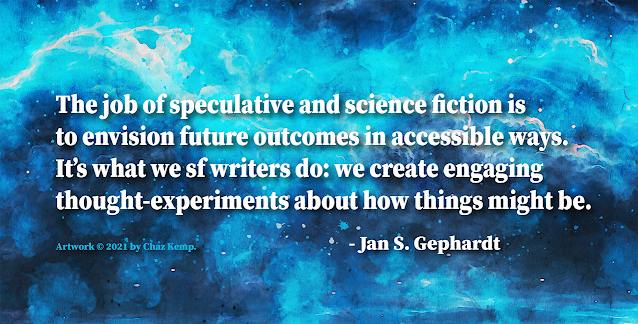
"The job of speculative and science fiction is to envision future outcomes in accessible ways. It’s what we sf writers do: we create engaging thought-experiments about how things might be." – Jan S. Gephardt.
(See credits below).


What Would Equal Civil Rights for All Look Like?

Equitable access to opportunities implies no glass ceilings, no systemic racism, and no history of apartheid and genocide – or appropriate reparations made, to recognize such a history. There’d be no antisemitism, no Islamophobia, or any other religious or ethnic bias. It would allow no gender, sexuality, identity, or age bias. (I’m already imagining the groans about political correctness, but wait! There’s more).

This hypothetical system also would accommodate for differently-abled candidates. We’d ideally be able to work out a system much like the “blind auditions widely adopted by symphony orchestras and other, similar venues. What system could we use? Mm. Good question. But I’d welcome ideas in the Comments, about how to achieve more equitable access to opportunities for everyone.

Equal protection under the law would yield racially proportionate rates of conviction and incarceration – something we’ve never had in the United States. It would end the need for Black parents to give their children “The Talk” about what to do when they are (inevitably, no matter what they do) stopped by police. It would end the criminalization of poverty and the routine abuses to persons experiencing houselessness. And it would mean public defenders’ offices were as well-funded and prestigious as prosecutors’ offices.


“I've always been driven by the concept of equal justice under the law, but only the rich can pay great sums of money for legal assistance and that puts them at an advantage over the poor.” -Samuel Dash
(Courtesy of Moonsling).


How about the Civil Rights the Civil Rights Movement Fought for?

An equal say in how we are governed would mean no gerrymandering (this a bitter issue with me right now, living as I do in the proposed-to-be divided Kansas Third District). It would mean that it would never be illegal to offer water and a sandwich to would-be voters standing in line for hours. It also would mean that no voters would have to stand in line for hours!

That there’d be widely-available mail-in balloting. That there’d be more than one drop-box for ballots in enormous districts such as Harris County, TX. And that all election officials would act in strictly nonpartisan manner.

An equal say in how we are governed would – in the United States – mean changes in the Senate (it’s extraordinarily undemocratic). Also, probably the abolition of the Electoral College (a system which routinely renders my Kansas-based vote for President irrelevant every four years). Both of these institutions were compromises designed to keep smaller states and minority populations from being drowned out by the influence of larger states. Neither “fix” is improving equity today in the way the Founders hoped.


"A vote is a prayer about the kind of world we want to live in." - Rev. Raphael Warnock
(See credits below).


Science Fiction and Equal Civil Rights for All

We need to see imagined worlds where it is possible to reach for, and maybe even achieve, more equal civil rights for all. In my opinion, one of the very best ways to do that is to create compelling, interesting stories about the future that show people what this concept would look like, feel like, and be like. Speculative and science fiction writers, this is our moment! Some of you may want to wallow in dystopia, but please! Offer us hope as well!

I care a great deal about equity and equality. It is one of the major themes that informs my science fiction. I designed Rana Station, the setting for most of my XK9 stories, as a place where all-too-fallible humans (and a couple of other species) try to create a place that helps all residents reach their full potential. But developing a vision for our world will need more than one small indie press, and more than one little-known writer advocating for better visions of the future.

It will need many more of us. It will need leaders in the field to stand up and say “this is worth writing about!” (thank you Neal Stephenson and Kim Stanley Robinson, for two examples of writers who are). Science fiction has changed the real world in many ways already. It’s time for us to do it again. And a good place to start is creating a vision of equal civil rights for all.

IMAGE CREDITS

Many thanks to Quote Thee for the Thomas Jefferson quote-image (originally from IZQuotes, but that page wouldn’t function for me). I also appreciate AZQuotes for the Harvey Milk quote; Quotesgram for the one from Elizabeth Cady Stanton; and BrainyQuote for the one from Chief Joseph (Montage by Jan S. Gephardt). And I’m grateful to Magical Quote for the Orwell “All animals” quote-image.

Angus Maguire created the “Reality-Equality-Equity-Liberation” image for Interaction Institute for Social Change, which holds the copyright and granted permission to use the image. I appreciate all! I created the “The Job of speculative and science fiction” image with some help from Chaz Kemp’s licensed Nebula 2 artwork, © 2021 by Chaz Kemp. This image was first used for my “Looking for Hope” post.

I’m grateful to Moonsling for the quote-image about equal protection under the law from Samuel Dash. I first assembled the quote from a tweet by the Rev. Raphael Warnock (now US Senator Warnock) in November 2020. It's now reformatted slightly and discovered that the background photo is originally from the Baltimore Sun, taken at the Maryland primary election, June 2, 2020 by the multitalented Karl Merton Ferron. Deepest appreciation to all of them!

Wednesday, February 9, 2022

Looking for Hope

Looking for Hope in an Era of Climate Change

The Future We Want, Part 2

By Jan S. Gephardt

Looking for hope in an era of climate change can seem like a fool’s errand.

Climate change is already upon us. This is not news to anyone who’s been paying attention. Remember those horrifying outcomes the climate scientists warned us about in the 1990s? They’re here. Happening now. The mega-storms, the super-wildfires, the changing weather patterns. Rising sea levels? Mass extinctions? Melting polar ice caps? Yup. All happening now.

Congratulations, climate-deniers! You, um “won”? The oil companies’ disinformation campaigns, combined with ghastly leadership deficits and rich nations’ widespread unwillingness to inconvenience themselves, have wrought the predicted result. So, now what? Is it “Game Over” for us now?


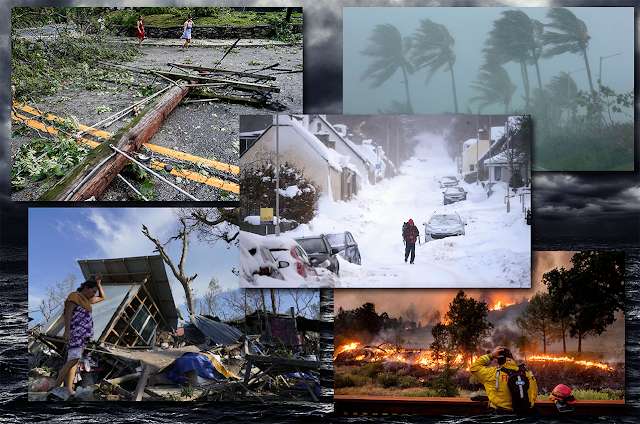
Weather disruptions these days come from ever-more intense tornadoes, hurricanes and typhoons, intense snowstorms, drought and wildfire.
Clockwise from top left, the aftermath of a tornado in New Jersey, Hurricane Irma in the Bahamas, wildfire in California, and the aftermath of Typhoon Rai in the Philippines. At center, a heavy snow in Scotland. (See Credits below).


What Have We Done?

Well, we’re not dead yet (not if you can read this post). If the goal was to avoid catastrophes, though, we can kiss that one goodbye, We screwed that up bad. Catastrophes are everywhere.

The United States offers a global microcosm. The deep south is the New Tornado Alley. Kansas wishes you all the best of luck, and advises you to build storm shelters. California is a near-year-round Burn Zone. Miami Beach and the Florida Keys are barely treading water (at least until the next King Tide), and the Pacific Northwest is still recovering from Death-Valley-like heat last summer. Oh, and . . . how many bomb cyclones have you Northeasterners weathered, in recent years?

If the goal is to avoid making it even worse, well, that, we still can do. But we need the will, the urgency, and the vision. Looking for hope in an era of climate change is hard, but it’s not impossible.


"People are suffering. People are dying. Entire ecosystems are collapsing. We are in the beginning of a mass extinction. And all you can talk about is money and fairytales of eternal economic growth. How dare you! You are failing us." - Greta Thunberg, to the United Nations Climate Action Summit, 2019
Greta Thunberg at the United Nations Climate Action Summit in 2019. (See Credits below).


What Can We Do?

First of all, we can stop kidding ourselves. Politicians and pundits who consider climate to be “one of many issues,” and mostly important to a small group of “green nuts,” are deluded. Anyone who doesn’t care about climate change at this point hasn’t been hit hard enough yet. Give it enough time and apathy, and it’ll be their turn soon enough.

Thanks all the same, I’d rather take a different path. And I know I’m not alone. I’m still looking for hope in an era of climate change. I fully realize that I could never in three lifetimes of stringent measures offset the deleterious effects of one poorly-managed feedlot or gas pipeline. But what a defeatist attitude, to decide that if I can’t solve it all, I won’t even bother. Get real!

No, I’ll do what I can – and one thing I can do is educate myself and then speak up. I can demand that polluters and outsized greenhouse gas-emitters be forced to change their ways. That wasteful habits be shunned and more eco-appropriate methods be rewarded.

And I can collaborate on a more hopeful vision. Looking for hope in an era of climate change only seems stupid and pointless to people who can’t see any way forward. How do I know this? Because I’ve already seen something like it before.


Photos from earlier decades show many drawbacks to pollution.
On a background of Bavarian trees killed by acid rain, the images include one of the many fires on the Cuyahoga River, this one in 1952; warning signs on roads in Times Beach, MO; shattered, thin-shelled duck and osprey eggs due to DDT; a lake killed by acid rain, and metal barrels strewn across Love Canal, back when it was a hazardous waste dumping site. (See Credits below).

Looking for Hope - Again

I think it’s important to consider what negative views of the future do to people – especially to young people. I remember growing up during the Cold War, and the heavy certainty that nuclear Armageddon wasn’t a matter of if, but when. That skews a person’s view of the future and what’s possible, believe me. It was only after I’d been an adult for while that I truly started believing we might not blow ourselves up after all.

Instead, it seemed we would choke ourselves to death on pollution. Do you remember the 1969 Cuyahoga River fire? How about the “dead” lakes of Europe, the Adirondacks, and Ontario, killed by acid rain in the 1960s through the 1980s? The fish kills, the lakes too dirty to swim in or eat fish from? The years when we thought bald eagles, ospreys, falcons, and other bird species were doomed to extinction? Do you remember Love Canal and Times Beach? I do (especially Times Beach, MO, which was near my in-laws’ home).

I remember living in a Kansas City where after a few years of residence doctors routinely expected our lung X-rays to show clouding. Where we could park our car outside overnight and the next day it would be covered in a fine layer of tacky, oily pollution. Where, when the wind came in from a certain direction the whole area would stink. All this, even though I lived in a “good” neighborhood, by the redliners standards. How bad must it have been in poorer neighborhoods of color?

Many organizations and agencies have been formed to address climate change around the globe since the 1970s. Here are just a few. (See Credits Below).


What Changed?

People started to notice, be outraged, and speak up. The Environmental Protection Agency and other, more global initiatives came into being because people saw a need, not because the government had something against Big Business. We also should recall that the EPA was created during the Nixon Administration. By Republicans. And although Nixon vetoed the Clean Water Act, a bipartisan vote overrode it. Yes, it was a very different world.

The EPA has always been vilified by some groups. But, backed by strong legislation such as the clean water and clean air acts and the endangered species act, it staved off many disasters. It created some unintended consequences, granted. But Love Canal-style cleanup sites come around far less often now. My neighborhood doesn’t ever stink, my lungs are clear, and the primary everyday hazards to my car come from birds and tree sap, not oily, nasty pollution.

Anyone who tries to claim that pollution standards aren’t necessary, or that we’ve learned better now so we can ease up on restrictions ignores reality. They’re either lying, or don’t choose to remember history. Self-interested humans and profit-driven companies will cut corners and costs, unless some greater power forces them to clean up their act and keep it clean.


“We are the first generation to be able to end poverty, and the last generation that can take steps to avoid the worst impacts of climate change. Future generations will judge us harshly if we fail to uphold our moral and historical responsibilities.” – Ban Ki-moon, Secretary-General of the United Nations.
What he said. (World Economic Forum).


Looking for Hope in an Era of Climate Change

Remember that point I made above, “consider what negative views of the future do to people – especially to young people”? It’s equally true in reverse. What if enough of us around the world could come together and throw our whole-hearted efforts into combatting climate change? We could still mitigate some aspects, and perhaps reach a new balance. But crucial to any such effort is a powerful vision of the positive outcomes we still can create.

Powerful, big-money-driven lobbying groups, twisted ideologies of denial, and short-term political concerns remain. They’ll keep short-circuiting the ever-more-more pervasive ongoing threats from continued climate change, if we don’t push back. And we can, we must push back.

But we won’t, if we don’t believe that positive change can still happen. That’s why we desperately need stories and popular media that offer visions of positive outcomes after appropriate effort.


"The job of speculative and science fiction is to envision future outcomes in accessible ways. It’s what we sf writers do: we create engaging thought-experiments about how things might be." – Jan S. Gephardt.
Consider this a pull-quote. (Nebula 2 background artwork ©2021 by Chaz Kemp).


Can Science Fiction Save the Planet?

No literary genre can create the changes that are needed. But the job of speculative and science fiction is to envision future outcomes in accessible ways. It’s what we sf writers do: we create engaging thought-experiments about how things might be.

And it is historical fact that science fiction has shaped, and continues to shape, the world we live in today. I’ve already written about environmentally-focused science fiction on the “Artdog Adventures” blog, as well as sf writers’ perhaps-lamentable tendency to envision ways we might destroy the Earth.

Dystopian stories envision how things can go terribly wrong, before their protagonists win their way to freedom and security (or tragically fail to do so). And Lord knows, we’re currently living in an environmental dystopia. But how about more hopeful future-environment stories? They’re available, too! Forbes recently published an excellent list, but it’s not exhaustive. And there’s definitely room for more.


“The Future is not something we enter. The Future is something we create.” – Unattributed.
Consider your actions and attitudes carefully. You're creating tomorrow, right now. (See Credits below).


A Vision of Hope for the Future We Want

We can envision the future we want, if we have the will and the imagination. We can take a proactive approach to finding better visions, as well. If we readers seek out more science fiction that ends well for the environment, we’ll get it. We need to ask for such books at bookstores of all kinds. Run online searches for them, ask for them in author forums. If we seek them persistently, publishers large and small will answer a perceived market need.

As a society, many of us are looking for hope in an era of climate change. We need fresh and positive visions to guide us. And we who write science fiction can offer a historically-proven place to start looking.

IMAGE CREDITS

The first montage was composed from many sources. Sincerest thanks to NY1 and the uncredited AP photographer for the New Jersey tornado damage photo, to ABC News for the photo of Hurricane Irma, and to ABC 7, for the uncredited wildfire photo. Thanks also to the San Diego Union Tribune and photographer Jay Labra, AP, for the photo of destruction left in Talisay, Cebu, Philippines after Typhoon Rai, and to The Guardian for the photo of snow in Tomintoul, Moray, Scotland, by photographer Jeff J. Mitchell/Getty Images. The stormy background is “Storm at Sea,” by plus69 via 123rf. Jan S. Gephardt assembled and designed the montage.

Deepest appreciation to Greta Thunberg for her iconic and straight-to the-heart words, to Wikipedia for making them available, and to the AP via the Los Angeles Times for the photo of Greta at the UN. Jan S. Gephardt assembled the quote-image for her blog post “It’s Okay to Feel What We Feel.”

Environmental Destruction of Yore

Many thanks to the sources of the photos used in the montage of climate destruction from the mid-20th Century. They include Wikimedia and an unidentified German photographer, for the background photo of acid-ran-killed trees in Bavaria, and to Ohio History Central for the photo of a 1952 fire on the Cuyahoga River, from the Cleveland Press Collection at Cleveland State Library. The photo of the DDT-damaged mallard duck eggs in the upper left of the montage is courtesy of the “Rachel Carson” blog from the Nanyang Technological University of Singapore, while the photos of similarly-damaged osprey eggs at bottom center and far right came from the “Osprey Tales” blog.

The photo of the gross-looking acid-rain-killed lake at the top is the header for Interesting Engineering’s article, “What Acid Rain is, and Ways to Restore the Damage it Causes.” (photographer unattributed). IDR Environmental Services provided the photo of Love Canal in the early days, when it was openly used as a hazardous waste dump by Hooker Chemical Company. It illustrates Part Two of a series on “America’s Hazardous Waste History,” by Dawn DeVroom.

The color photo of the Times Beach “Dioxin” road was taken by legendary St. Louis Post-Dispatch photographer and Missouri Photojournalism Hall of Famer Robert LaRouche. The black-and-white photo is a 1982 photo by James A. Finley/AP, provided by Legends of America in their article “Ill-Fated Times Beach, Missouri.” Jan S. Gephardt assembled and designed the montage.

Environmental Agencies of the Globe

This montage shows logos and headers from a small fraction of the many governmental and non-governmental agencies and organizations from around the world that have developed since the 1970s to combat climate change. They include the United Nations Decade of Ocean Science for Sustainable Development (courtesy of EurOcean), United Nations Climate Change Global Climate Action, and the United States Environmental Protection Agency.

Others whose logos are represented are the Caribbean Community Climate Change Centre (courtesy of PAHO, the Pan American Health Organization), The African Climate Foundation, and the Climate Action Network of Southeast Asia (CANSEA). Many thanks to all, and good luck with your varied missions! Montage by Jan S. Gephardt.

A Collection of Quote-Images

Deepest thanks to the World Economic Forum, which provided the Ban Ki-moon quote-image as part of an excellent collection. This image also was featured in an earlier Artdog Adventures post as an Artdog Quote of the Week (contrasted with one from the disgraced, twice-impeached 45th US President, in 2017), but I thought it fit so well I’d use it again.

The background artwork for my pull-quote on the job of speculative and science fiction is Nebula 2, © 2021 by Chaz Kemp.

I’m sorry to say that QuotesHunter (my original source for the “Something We Create” quote-image) doesn’t seem to be around anymore, but you can still find this image on my Artdog Adventures posts “Creating Well” and "The Future we Want, and How to Get There." It's something of an emblem for this “The Future We Want” series.