Monday, October 17, 2016

Piecing it together

Artdog Quote of the Week


IMAGES: Many thanks to Immigrant Times for the puzzle-pieces photo, and to Quote Addicts for the Felix Adler quote. 

Saturday, October 15, 2016

Just Don't

The Artdog Image(s) of Interest
As you contemplate the upcoming Halloween season, remember:


In Wednesday's post I discussed cultural appropriation, and how it differs from cultural exchange. If today's post startles or confuses you, might want to look back at that one again.

IMAGE: Many thanks to Iffat Karim in The Rattler for this collection of images.

Wednesday, October 12, 2016

Cultural exchange, versus cultural appropriation

According to some people, I have an unsavory past.

Well, not me, personally. I've never committed any crime worse than exceeding the speed limit, and I'm pretty sure that's true for most of my immediate family as well. We don't tend to be colorful in that way.

What lurks in your family tree?

But I have both English and German roots, and the last several generations of my European-American ancestors have lived in the United States. In the eyes of many people around the world, those simple facts make me and my family complicit, at least by association, with centuries of oppression, racism, and perhaps even genocide.

Not much I can do about it, no matter what my ancestors thought or did. But in the minds of some, my ancestry and presumed understandings make me a suspect interpreter of culture. How dare I even try to make art about any culture but my own? Isn't that tantamount to cultural appropriation?

Yikes! Um, well . . . no, actually. For good reason.
First, like many people, I've tried to live my life in as fair and unbiased a way as I can, but the fact is that sometimes we don't realize what we've done or said (or what those things mean to others--see below) until we've had our consciousness raised. Every one of us is a product of our culture, and it's only through experience that we can learn more appropriate approaches and frames of reference.

Artist Kristen Uroda created this image for NPR, to help convey the concept of a frame of reference. It's also an illustration of my point that art can help us understand our world

In other words, none of us will get it right 100% of the time. But cross-cultural understanding can be built, even by unsavory characters such as me. It requires mutual respect and openness, and patience with each others' mistakes.

Why try? When we don't understand something, our brain still tries to make sense of it. That's an innate response. We don't always get it right, because synthesizing from impressions and separate events is an inaccurate process. But the human brain seems hard-wired to try.

I've always seen artists (in all of the arts disciplines) as crucial to the process of building cross-cultural understanding--and in our ever-shrinking world, where globalization affects lives everywhere, developing more and better tools for cross-cultural understanding is becoming ever more vitally important.

Yet anytime we consider a cultural exchange, there tends to arise the concern over cultural appropriation.

Cultural  Exchange is a healthy, desirable, increasingly necessary function in society. Governments, organizations, and businesses are wise to foster it whenever possible.


Cultural Appropriation is a perversion that wounds, and inhibits mutual growth. It is what happens when members of a dominant culture ignorantly or disrespectfully use racial stereotypes or the outward symbols of a less-dominant culture for its own gain or racist purposes. Unfortunately, people who look like me can stumble all too easily across this line. Consider these examples:


But we've already established that we don't get it right 100% of the time, especially when we encounter an unfamiliar culture. How and where do we draw the line?

First must come the awareness that there is such a thing as a dominant culture. Moreover, membership in a dominant cultural group automatically bestows privilege. When you ignore privilege, you lose an essential perspective that is important for helping you see where that line falls.

That's why people who look like me, and whose ancestors came from the places my ancestors did, are automatically suspects, when it comes to cultural appropriation. Whether we want to be or not, and whether we think it's right or not, we're privileged. THAT'S my "unsavory past," noted at the top of this article. When you automatically have had privilege all your life, it looks "normal."


And it's really easy to ignore, until you've had your consciousness raised to the fact that everyone else who doesn't look like you has to evaluate situations based on your privilege, and work around it.

After that, drawing the line gets a lot easier. Cultural exchange is mutual. It enriches members of both cultures. Cultural appropriation demeans members of one culture for the amusement or gain of more-privileged members of another. Ultimately, it comes down to RESPECT. Without it, every single one of us is an unreliable witness.


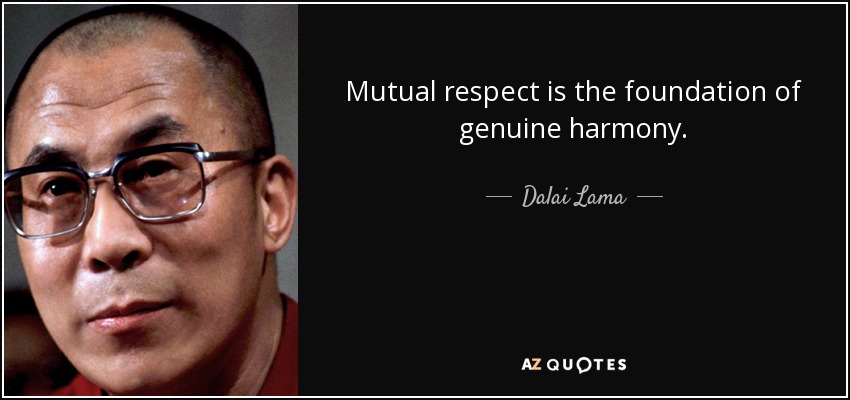
IMAGES: The elaborate family tree chart by Pietro Paolini is from the Castello di Nipozzano in Tuscany, courtesy of The Independent. Many thanks to NPR and its Invisibilia shows, for Kristen Uroda's simultaneous illustration of two of my points. I am grateful to Top Famous Quotes for the Abbe Pierre quote and image, to Iffat Karim and The Rattler for the "Native Americans" example of cultural appropriation, to illustrator Terry Tan, whose illustration, "Cinco de Mayo/Drinko" was posted in a very good article by Matt Moret in ThePittNews, and to Wikipedia for the poster image from a minstrel show in 1900. Many thanks to The Orbit, for the nutshell definition of privilege (the essay that goes with the image is a good one, too). And finally, many thanks to A-Z Quotes, for the Dalai Lama image and quote.

Monday, October 10, 2016

Saturday, October 8, 2016

The Pot and the Bowl

Artdog Image(s) of Interest 


We often hear that the United States is a great big melting pot, where immigrants come from all over and get assimilated, so that they can become Americans. As you can see from the style of the image above, this idea has been around for a while.

This "melting pot" idea assumes the cultural differences will get melted right out, and we'll all turn into generic Americans. Everybody will share the same cultural references, speak English, and leave the Old Country behind.

It's balderdash, of course. People don't "melt" that easily, and they can only interact with the world via the cultural references they have. Even several generations after the first, many aspects of a person's cultural heritage live on in them. I do like the "Equal Rights" spoon Miss Liberty is using to stir us with, though. It would be nice if we saw that spoon a lot more often in public life.


Or maybe we're like a salad bowl, as a more contemporary image says: all the assorted individuals mix together and interact with each other, but they maintain most of their original flavors and characteristics. (in this illustration, is the English language kind of like the . . . salad dressing?)

I'm not sure that's an entirely apt metaphor, either, because after a while we do grow more like our nearer neighbors, while older ties and influences may loosen. Assimilation may never be total, but it is an important force.

Fact is, neither is a perfect image, because people aren't (normally) pieces of food. We're way more complicated than that. This is a worry and an irritation to those who like to keep things simple, but I have a feeling those folks have enough frustrations already: life is rarely uncomplicated.

If you're the kind of person who lives in fear, then the "otherness" of people from different cultures can be frightening. If you're the kind of person who finds variety to be the spice of life, then nothing tastes better--pot OR bowl--than cultural diversity.

IMAGES: Many thanks to the WYPR article America: Melting Pot or Salad Bowl? for the image of Melting Pot Stirred by Liberty, and to the Oswego (NY) City Schools Regents Prep website for the Salad Bowl of Immigration image. 

Monday, October 3, 2016

An impossible mission?

The Artdog Quote of the Week 


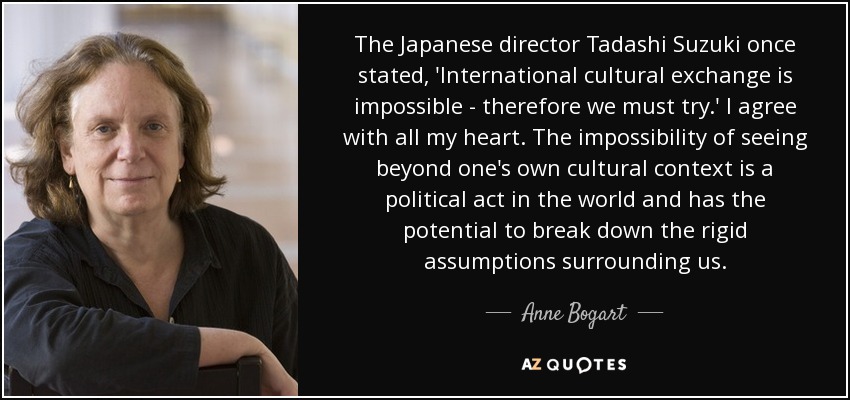
I'm not sure Suzuki is correct--either that international cultural exchange is impossible, or that it is impossible to see beyond one's own cultural context.

Instead, I think that when people from different cultures interact, they almost inevitably are affected by the new ideas and approaches they encounter. Far from being impossible, it seems to me that cultural exchange is inevitable.

Moreover, once cultural interaction has taken place, the new approaches or ideas (or visuals, or sounds, or flavors, or any of the other aspects of cultural interaction) have been experienced, they are impossible to un-experience. And what does that change? Cultural context.

Not completely, of course. Not all the way to seeing in terms of the newly-experienced culture's context, certainly. But it still can be interesting, startling, or occasionally even life-changing, to experience life surrounded by a culture not our own.

Suzuki and Bogart are correct, however that making the effort to see beyond one's own context has the potential to break down rigid assumptions. And once the walls of those assumptions have fallen, who knows what creative things might happen?

IMAGE: Many thanks for this quotation and image to A-Z Quotes.

Saturday, October 1, 2016

When cultures meet, stuff happens

The Artdog Image of Interest 


This week's Image of Interest is The Japanese Parisian, painted by the Belgian painter Alfred Stevens in 1872. It was painted during a time period when Europe had begun trading with a newly-opened Japan (the Meiji Era), and many European artists, intellectuals and elites were seized with a deep fascination with Japanese art and culture.

Japonisme, as this fascination was called, influenced many aspects of European culture and arts. It inspired and revolutionized the work of the Impressionists and Post-Impressionists, including Monet, Degas, Van GoghGaugin, and Whistler, as well as the Art Nouveau movement.

The allure of the exotic, the fascination with other cultures and their arts, is a human reaction we've seen in many times and places. But when is it a healthy cultural exchange, and when is it cultural appropriation?

I plan to spend some time this month looking at that and related questions, as we move toward Halloween, the Days of the Dead, and all the opportunities to explore other cultures--or cross inappropriate lines--that abound at this time of year.

OUR IMAGE: Many thanks to Mimi Matthews for a very nice image of one of Alfred Stevens's more famous paintings.